March 2008 Archives

Moby-Dick update 3

| | Comments (5)

I'm overdue telling you this: I finished "Moby-Dick"!

I wrapped it up on Easter weekend. Sorry for the delay; "Hal Linker" got in the way.

The final three chapters follow the last three days of the hunt for the white whale. Read the first on that Saturday, then the final two on that Sunday at Coffee Bean -- fitting, since I'd read so much of the novel there. Except it was so hot I got an iced drink to cool down, not my usual, a hot drink to warm up.

A little sobering to note that between when I started the book (Jan. 1) and when I finished (March 23), the seasons had turned.

For the record, the ending did nothing to dissuade me from my opinion that "Moby-Dick" is awesome. In fact it reinforced that feeling.

My plan is to write a column about "Moby" in the near future. In the meantime, let the heavens ring with the news that I've completed my quest, a bit more happily than Ahab did.

[To represent the letter L, I gave serious consideration to writing about lowrider cars, knowing that's part of modern-day Pomona culture. But frankly, I had no idea where to get started on that topic. Lawn bowling was another possibility. Instead I opted for the topic likeliest to get a "wow" from the average reader: the Laura Ingalls Wilder collection at the Pomona Public Library.

I know some library employees (Hi, Ms. Lois!) are excited about seeing this column reprinted here. The only update is that Marguerite Raybould has retired as children's supervisor, replaced by Nissa Perez-Montoya. Oh, and the children's room, like me, now has its own blog.

Call me a softie if you must, but the last quote, from Wilder's letter, makes me mist up each time I read it.

This column was originally published Oct. 3, 2004.]

'Little House' fans find a home in Pomona Library

"Pomona A to Z" continues to place the city's unlimited layers in the limelight and, I hope, add luster to a sometimes hard-luck city. Now in Part 12, clearly this series is no lark.

Just as clearly, we're up to the letter L. Among the candidates worth a look:

* Lowriders, an important part of car culture in Pomona, where the movement's bible, Lowrider Magazine, was founded (even though the magazine later cruised down to Fullerton).

* Lawn bowling, a game popular in the United Kingdom and worldwide, still played at the Pomona Lawn Bowling Club.

* Lamp lab at Pomona's BAE Systems, a manufacturer whose lamps allow military aircraft to jam heat-seeking missiles.

* Lincoln Park, a neighborhood on the National Register of Historic Places and one of the city's prestige addresses.

A laudatory list! Yet our lantern of learning will light upon a different L: the Pomona Library's "Little House on the Prairie" collection.

Little lasses, and even lads, have long loved the books by Laura Ingalls Wilder (1867-1957) about her childhood in the 19th century as a Western pioneer.

I may not be as wise as Pa, but I do know that Wilder had a special connection with the Pomona Library -- an institution that isn't on the Chisholm Trail.

No, she formed that tie late in life when she corresponded with a librarian, wrote a letter to the children of Pomona, donated an autographed set of her books and even gave the library a rare gift: the original, handwritten manuscript for "Little Town On the Prairie."

And speaking of pioneers, you might say Pomona was a pioneer itself in recognizing the importance of her series.

The Pomona Library was the nation's second to honor her, naming its children's department the Laura Ingalls Wilder Room in 1950.

Wilder didn't attend -- she was in her 80s, and her husband had just died -- but from her home in Missouri, she wrote a letter to be read aloud. A copy is still on display.

"It makes me very proud that you have named this room in your library for me," Wilder wrote in a neat cursive. "...You make good use of your library I am sure. How I would have loved it when I was young, but I was far from a library in those days."

Far from running water and flush toilets too. From 1869 to 1879, young Laura Ingalls and her family -- Ma and Pa Ingalls and sisters Mary, Carrie and Grace -- lived in frontier settlements in Minnesota,
Kansas, Iowa and South Dakota.

The family endured many hardships: terrible winters, poor crops, Mary's blindness and Michael Landon's curly perm.

Laura married Almanzo Wilder in 1885 and only turned author in 1932 with "Little House in the Big Woods." An immediate hit, the memoir spawned seven sequels.

One fan was Clara Webber, the Pomona children's librarian from 1948 to 1970. She corresponded with the author and hunted down Ingalls family homesites on her vacations. Even Wilder wasn't sure where they were.

"Miss Webber was really one of the first people to realize what a national treasure these books were," said Marguerite Raybould, the library's supervisor of youth services.

An alcove dedicated to Wilder displays family photos, foreign editions -- such as the Swedish "Det Lilla Huset Pa Prarien" -- character dolls and the "Little Town" manuscript in pencil.

Raybould admitted the alcove isn't exactly spellbinding stuff. What gets young readers excited is the library's annual Laura Ingalls Wilder Gingerbread Sociable, a birthday party that began in 1967, the centennial of her birth.

The party features gingerbread, an Ingalls family favorite, and period music of the type Pa played on his fiddle. About 300 children and adults attended the one in 2004.

The 2005 sociable, the 38th annual, is set for Feb. 5.

Despite changing times and demographics, children still ask for the series by name -- "although it's no Harry Potter," admitted librarian Lois Robbins.

"The fact that it's a story of immigration and going to a new place with possibilities," Raybould said, "has resonance for lots of people."

So do the emotions. That's what Wilder, in her letter to Pomona's children, suggested would keep her books contemporary.

"As you read my stories of long ago I hope you will remember that the things truly worth while and that will give you happiness are the same now as they were then," she wrote.

"Courage and kindness, loyalty, truth and helpfulness are always the same and always needed."

(David Allen writes Sunday, Wednesday and Friday, lovingly.)

This week's restaurant: Casa Blancas Mexican Food, 300 S. Indian Hill Blvd., Claremont.

You may know Casablanca, the Mediterranean restaurant in the Claremont Packing House. But do you know Casa Blancas, the Mexican restaurant three blocks south at Arrow Highway?

I stopped in there two weeks ago for dinner before seeing a movie at the Laemmle. That was "4 Months, 3 Weeks and 2 Days," the Romanian abortion flick that, while worth seeing, was such a downer it may qualify as the feel-bad movie of the year.

Casa Blancas was previously a Green Burrito, with a couple of iterations in between. Thus, my expectations were low. The interior, however, had a lot of colorful tile, and the menu seemed promising.

At the counter, I ordered two grilled shrimp tacos and a Jarritos soda ($7.56 with tax). The salsa bar had been converted into a trough of ice filled with bottled Mexican sodas, not only Jarritos but Mexican Cokes. Nice, although too bad it's not a salsa bar. The tacos were the smallish, real kind, served on corn tortillas and loaded with cabbage. They were quite tasty. The soda proved a good pairing.

Casa Blancas was a pleasant surprise, likely the most authentic Mexican restaurant in Claremont (not that there's a lot of competition, granted). It's a good place for a quick, cheap bite in an often-pricey town.

And if you're curious, I did try two new-to-me restaurants this week: La Verne Pizza Co., where I had an adequate if unexciting pepperoni slice and salad, and Rok the Wok in Upland, where I had a below-average chicken teriyaki bowl. I'd rather highlight a worthwhile place, even if it's a couple of weeks old.

As the crazy man in the sandwich-board sign could tell you, The End is Near. Today ends the serialization of the mammoth e-mail from reader "Hal Linker." Well, except for a single-topic piece that's worth its own entry, sometime next week.

Based on the number of comments, a lot of you have enjoyed this string of recollections of the valley in the 1960s and 1970s. This last section might be my favorite, as "Hal" talks about the early years of Montclair Plaza:

I remember when the Montclair Plaza opened in the single-level format. My mom and older sisters would go shopping for dresses and stuff and I went along, being as I was still (barely) not old enough to drive. I would ditch the women and drool over records and stereos.

We used to park on the Broadway side of the mall. I can still remember the smell of leather and patchouli and the stereos with light boxes playing Smith's "Baby It's You," or Crosby Stills & Nash's "Suite Judy Blue Eyes" blasting out of the record department in JC Penney's, or Jethro Tull's "New Day Yesterday" resonating in the May Company record department.

Thunderclap Newman was making a joyful noise at Pedrini The Music Merchant amidst all the pianos and organs. It was Creedence, Three Dog Night, Steppenwolf, Abbey Road, CSN&Y, Ten Years After, Jimi Hendrix, Sly & The Family Stone, Jefferson Airplane time, baby. Almost everything being released on record was great (at least from my perspective).

That's what was happening when the Plaza opened. It was the advent of the black lite poster, the strobe light era. The counterculture becoming the over-the-counter culture and hitting the mainstream. But the tunes held up pretty well. Sadly, everyone forgot about the Pomona Mall and Pomona hit some bad times.

Yes, the Hollander and the Jolly Roger were the places to eat in the mall. Jolly Roger, dimly lit with great burgers, served me booze when I was 15. Yes! (Nobody cared then. It was in many ways a much cooler time, with much less government control and brainwashing.) I don't remember the Slob's Big Boy someone mentioned being in the Plaza. Must be a memory block, maybe it came later or maybe that person is wrong.

Orange Julius was near See's Candies past JC Penney and served dogs. Across Moreno was Van De Kamp's which much later became Tiny Naylor's for a bit. Eventually, the Hollander moved outside of the mall into a space previously occupied by Dugan's Music. That was the death of the Hollander -- bad move, but they might not have had any choice.

Speaking of Dugan's, next to it, with an adjoining door, was Discount Record Center. This was a rather small long narrow store but its selection was amazing. I loved to browse there and was awed with their full catalogs on most of my favorite artists. They even had all of Zappa and the Mothers' stuff which, even then, was an extensive catalog.

I actually worked there for about two months before realizing it was a dead-end career. I dug the tunes but seemed I was demonstrating bongs to more people than selling records. Those girls from the adjacent Marinello's Beauty School kept coming in there and buying bongs so I followed one of cutest of them to Venice where she opened up a salon and we lived happily, but not ever after.

Was this succinct enough for you? They don't call me enormo-mail for nothing. But, dammit, this blog deserves it!

Very kind of you, "Hal." Everybody give him a hand for a job of memory-plumbing well done.

Sonorous announcer: When we last left "Hal Linker," he was reminiscing about restaurants. As we resume today, he is still reminiscing about restaurants. But first he mentions a clothing store:

Robert Hall's was the cheap suit place that my parents took me to because I would grow out of them so fast. Located east of Central on Holt.

Re: Betsy Ross: Who didn't love the place! Wolfing down a Gettysburger with a chocolate malt or coke and then getting a Paul Revere (their version of a banana royale) to top it off. The red, white and blue-themed restaurants only had five locations. Pomona Valley Center opened 1955, Foothill near Mountain in Upland opened 1964, Foothill near Griswolds opened 1959, Grand Avenue Glendora opened 1969; 969 East Holt 1958. There was also an original location on Garey which was ice cream only.

Another couple of historic Chino restaurant locations:

* The Big W on the NW corner of Riverside Drive and Benson. The Big W is long gone, torn down in the 1960s. A 7-Eleven now sits at its approximate location.

* The Pizza King, also on the NW corner of Riverside Drive and Benson. The Pizza King was in the approximate location of Flo's No. 2.

* Gold Rooster restaurant on Central just south of Mission. Building still stands but is now Players or something like that, a pool playing bar. The Gold Rooster was an affordable restaurant with delicious chicken and halibut and steak at a good value.

Will Hal find love? Will he stop eating out? What does he remember about Montclair Plaza? And what about ... Naomi? (Sorry, a little "Electric Company" humor.) Tune in tomorrow for the final (?) installment of "As the Valley Turns."

As "Hal" continues disgorging the entire contents of his brain, minus the parts he's leaving on these entries as comments, he focuses on more restaurants:

In the 1970s I remember a lunch only place on Foothill in Claremont called Soup's On. Anybody ever go there? I went once or twice and it was very popular.

The Laugh Stop was also happening around the Griswold's area in the late 1970s.

Anybody remember Baja Pete's in Chino? Obviously it was a Mexican place in the 1970s and 1980s. I used to really dig the enchilada suizas there -- the rest of the food was OK but nothing super fantastic. Never have found a restaurant that could match those suizas since (though Las Casueles in Palm Springs comes close). The building still stands but got gutted of its atmosphere. It's now called Plaza Guadalahara and is a non-waitress, counter order joint. I don't like it.

There was a small taco stand on either Mission or Holt in Ontario called La Fonda. It was fantastic. Then one day they moved to a strip mall portion of a grocery store center on Euclid and Francis and they started sucking.

My faves were Orlando's, Espiau's and The Arbor, which had a hotel adjacent to it which made for some super long dinners and happy hours.

Another Tastee Freeze location was on Euclid adjacent to a Circle K on the west side of the road somewhere between Francis and Mission. The building's still there but it's a Loco Pizza or something now -- the Circle K is no longer a Circle K either. I think someone mentioned the location on South Garey in front of the old Alpha Beta market with the A-frame latter-day design.

Someone mentioned Ozzie's Oasis in Montclair on Central near Kingsley. There was also a location in Chino on Riverside Drive and Ninth. One of the few burger joints that served sloppy Joes. When they closed, the building was remodeled and became Pearl City, a Chinese restaurant which lasted about a decade. Not sure what's there now.

There was also a Tastee Freeze on East Mission east of Garey in the A-frame style that's now a Bamboo Express. Next: yet more restaurants, in the penultimate excerpt. The end is in sight, folks.

As we continue serializing what was originally intended as a comment on the "Things That Aren't Here Anymore" thread, "Hal" (in quotes since we now know this is a pseudonym) is yakking about teen clubs of the late 1960s:

How about the Pacesetter? The building still stands and I think is called Mi Hacienda (last I checked). The Pacesetter was a teen club which opened circa 1967. The Standells, The Seeds and many other bands played the venue which also had the obligatory Battle Of the Bands competition.

(Someone told me Pink Floyd played there when Syd Barrett was still a member. I find that very hard to believe, because I would have gone! At any rate, it couldn't have been any good given Barrett's mental state on that disastrous 1st U.S. tour.)

My band was in a battle of the bands at the Pacesetter and did place second, but the two of us who were on the basketball team got kicked off for participating in a worldly activity. Ah, the joys of going to a parochial school. Now they have rock bands in their churches.

Not in the Inland Empire but just over Kellogg Hill was the Carousel Theater in West Covina. Great place for rock 'n' roll shows in the mid to late 1960s. These were held on dark days from their typical musical stage shows. Doors, Rascals, Simon & Garfunkel, Animals, Dave Clark Five, Buffalo Springfield, Byrds, Seeds, etc. all played there. Wallich's Music City also had a store location in the same general area. It later became the short-lived Big Ben's Records. Both buildings torn down.

Cal Poly hangouts were the Pic and Pan and The Library on West Holt.

Next time: more restaurants.

Thus begins Week 2 of the Hal Linker papers, which could have been donated to Chaffey College but instead were sent via e-mail to me. Resuming where we left off Friday, today he focuses on burgers, fried chicken and tacos:

Let's not forget The Towne House, a burger hangout on Towne and Holt from eons ago.

Also A&W in Chino, on Riverside Drive and Wright. Too bad about the Ontario A&W carhop location closing in 2006. Bummer! But they weren't serving the old cuisine of Mama, Papa, Teen and Baby Burgers anymore anyway. Still they had Coney Dog Tuesdays. Damn! The Chino location still stands and is an Andy's Burgers -- no carhop service though.

With regard to other Ontario eateries, on Mountain Avenue there was the extremely short-lived Minnie Pearl's Chicken which became The House Of Omelettes which also didn't last long -- too limited on the cuisine maybe? I think the building is still there but I don't know who's operating out of it currently. I think Mexican food, maybe.

With regard to Mexican food: I dug Mingo's on Mission and Reservoir where I would always order the Gringo Burrito and Colorado Kool-Aid among the dangling pinatas. Also in Chino on Central near Riverside Drive was Mr. Taco, a takeout joint with no drive-through. They used to have a fire pit out front, back in the fearless days. Sometime in the late 1970s or early 1980s it was renovated and turned into a KFC. They had the bomb burritos back when we didn't use that slang.

Whatever happened to the many Winchell's Donut locations? Chino had one on the SE corner of Central and Riverside Drive (torn down for street widening). There was also one on Euclid in Ontario around Francis which is now a Juan Pollo.

There was a Pup 'N' Taco on Mountain and Philadelphia which got absorbed into Taco Bellsville.

Everybody remembers Henry's -- It was THE hang out. I used to cruise it with my older brother and sister. Those were the days! Souped-up cars and leaded high-octane gas at about 25 cents a gallon. Only drawback -- smog as thick as molasses. Musta been the factories -- couldn't have been the cars. And that Googie space age architecture! Yeah!

Other chicken joints were Unruh's on N. Garey and Litte Bill's on S. Garey just up the street from Pomona Lanes on the opposite side of the street.

Next time: teen clubs.

[Nothing to explain or update in this one. If you want the proper atmosphere, eat a bowl of cereal while reading -- but don't spill milk on your keyboard. This column was originally published Sept. 26, 2004.]

Pomona's K is for a man who was truly grrreat!

Welcome back to "Pomona A to Z," where we host a kaffeeklatsch about the city's key keepsakes, bringing knowledge, and kindling respect, in those who knock Pomona in kneejerk fashion. (The knaves.)

Did you guess we're up to the letter K?

Kidding aside, Pomona has a lot of keepers among its K candidates. Among them:

* Kaiser Bill's Military Emporium, the Antique Row business whose owner, Dave George, identified the obscure military medal worn by Michael Jackson at his arraignment in January -- a Serbian "bravery" medal -- and was quoted worldwide.

* Kress Building, once a department store and now Robbins Antique Mart, said to be Southern California's oldest and largest such store.

* Koosh Ball, a squishy, spiky plastic gel ball created by two Pomona High alumni that was the top-selling Christmas toy of 1988.

* Walter and Cordelia (Honaday) Knott, two more Pomona High alumni, who married and founded Knott's Berry Farm.

Keen, eh? What a kaleidoscope!

Our K, however, is special. You might even say it's a Special K, because K is for Kellogg.

The man behind Kellogg's cornflakes was W.K. (Will Keith) Kellogg (1860-1951). The son of a broom maker, Kellogg never got past sixth grade, but he built a cereal empire in Battle Creek, Mich.

The cornflake king spent winters in balmy Pomona, where he established a horse ranch. He later donated the land for what became Cal Poly Pomona -- the only hall of higher learning that doesn't get soggy in milk.

To learn about all things Kellogg, I met with Melissa Paul, curator of Cal Poly's W.K. Kellogg Arabian Horse Library. For the proper tone, we chatted over a breakfast of Kellogg's cereal -- she had Rice Krispies, I had Frosted Flakes -- in Kellogg West, a university dining hall.

After a stint as a traveling broom salesman, Kellogg went to work for his brother, nutritional pioneer Dr. John Harvey Kellogg, at his hospital and health spa.

The brothers experimented with cereal grains to create healthy foods for patients. Through a wacky accident in the kitchen, they came up with flakes that eventually revolutionized the way America eats breakfast.

Don't you hate it when that happens?

Although he was competitive, astute and rich, Kellogg was a shy man who treated employees well and gave away most of his wealth to help children and animals.

He especially loved horses. He had a horse as a boy that was part Arabian. His father sold it.

"It broke his heart," Paul said. "He vowed that if he ever was rich, he would buy a whole herd of Arabian horses."

Making good on his pledge, Kellogg bought 11 Arabian horses from a man in Indio in 1925, then plunked down $250,000 for 377 acres in Pomona for a horse ranch.

Lore has it a coin flip is what led Kellogg to buy the Pomona site over property in Santa Barbara.

Stables were built first so his Arabian horses would have a place to live, while Kellogg was content to rent a home in Pomona's Lincoln Park neighborhood.

Kellogg bought the best horses, many from England, and hired architect Myron Hunt to design some ranch buildings.

The ranch got plenty of visitors. They included movie stars Mary Pickford, Clara Bow, Gary Cooper, Olivia de Havilland and Tom Mix. Weekly horse shows catered to the common folk.

"Kellogg Ranch was the leading tourist attraction in Southern California in those days," Paul said.

Kellogg Arabians were used in movies, too. One was even the model for Prince Charming's horse in Disney's "Snow White."

In 1932, Kellogg donated his 750 acres and 87 Arabian horses to the University of California. But things didn't go as planned and the property fell into disrepair.

After a public outcry, the holdings were transferred back to Kellogg and then to California State University in 1949.

Stipulations were made to ensure the horses and horse shows remained, and they do.

The first classes were held in Pomona in 1956. A decade later the campus became a full-fledged state college, bursting with snap, crackle and pop.

Kellogg died in 1951 at age 91. Though the millionaire was a modest, self-effacing fellow -- "He was certainly no Donald Trump," Paul said -- he's hardly a forgotten man.

Not only is his signature on every box of Kellogg's cereal, but he left his mark on Pomona by enabling the city to get the valley's only state university.

Raise a cereal spoon in his memory.

(David Allen writes Sunday, Wednesday and Friday, more flakes of corn.)

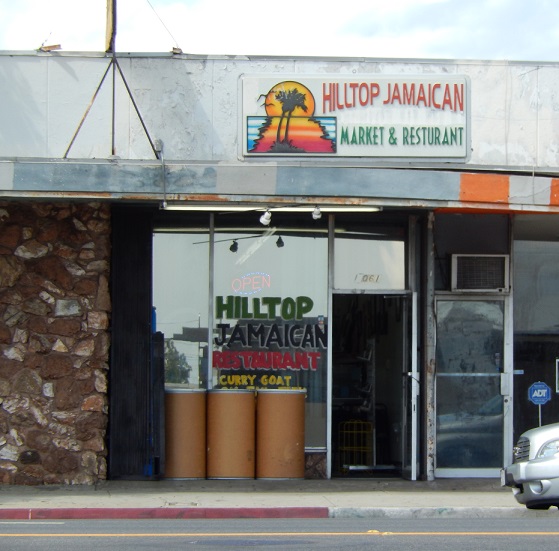
This week's restaurant: Hilltop Jamaican Market and Restaurant, 1061 E. Holt Ave., Pomona.

Their business card says Hilltop's, the signs say Hilltop. I'll go with Hilltop. Anyway, I've passed by this place for years and, while forever meaning to investigate it, always came up with excuses not to stop. Hilltop is in a narrow storefront in an aging building and the curb is painted green. The neighborhood is slightly dubious. But finally I stopped for lunch last Wednesday.

Hilltop turned out to be much more restaurant than market. There are a half-dozen tables and on the walls are amateur drawings and paintings. No customers were present at 1:30. The market consisted of a corner with shelves stocked with shakers of jerk seasoning, packets of curry powder and cans of breadfruit slices.

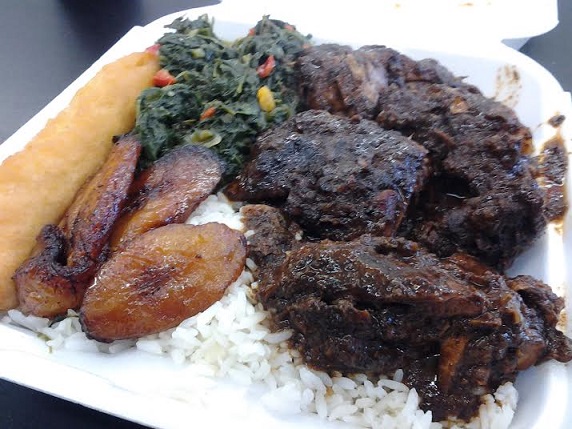
At the counter, I asked the employee for a recommendation. "First time?" he asked. He suggested oxtail stew. The small plate is $10 and came with rice, plantains, cabbage and fry bread. I got a ginger beer from the refrigerated case. He didn't charge me for the drink. "I gave you a discount," he said.

I have no basis for comparison but certainly enjoyed my meal, eating every bite except for some rice. In fact it was so filling I didn't even need dinner.

Hilltop also sells fried chicken, curry goat, curry chicken and fish patties, which the paper menu reports are sold in restaurants in L.A. and at the Bob Marley Festival in Long Beach. My guess is that takeout, catering and perhaps wholesale are a bigger part of their business than the dining room.

But for the adventurous, I recommend the place, mon.

Let's read what Hal has to say about bars in the fifth excerpt from his e-mail, which the Guinness people may want to measure for a world record:

Narod's in Chino (on Central between Washington and Walnut) had some nightlife and reasonable food, and they had very attractive waitresses, two of whom I dated, circa the cocaine era. I just didn't dig the overall redneck nature of the clientele. The building survives and is occupied by Godfather's.

The Little Club on Central in Montclair pretty much fit the same description. It became a Latino bar for a long time. Might be a sports bar now. I'd hate to own a bar now with the current climate towards drinking. Everybody's pretty much legally drunk just because they walked into the place.

(I used to milk cows and finished work about 3:30 a.m. I can't tell you how many times I was pulled over while driving home, not because I was drunk, but because I was out on the street at that hour. It really sucks to be perfectly sober and get pulled over, get forced to do a sobriety test, have a warrant check run on you, just because you are driving around at a weird hour.)

For more interesting nightlife there was The Broadside on West Mission in Pomona. The Mothers played there before fame; later it was Walter Mitty's, and Van Halen played there before being famous.*

But let's face it, if you really wanted quality entertainment you had to head for Hollywood: The Whisky, Troubadour, The Roxy (after 1973), Gazzari's/Billboard Live/now the Key Club, Classic Cat -- all of which except the Classic Cat (best strip joint of the late 1960s/early 1970s) still stand, although only shadows of their former glory.

Who mentioned The Green Door? Central in Montclair. Some name acts played there in the 1980s. Located near the old Holiday Skating Rink and the wonderful Holiday Liquor which supplied kegs for so many of my parties, in the days when everyone cut everyone some slack. Anybody remember the
huge parties which were thrown on Arrow near Central with live bands and scores of kegs? And that rundown motel on the property too.

I have a story that ties all of these locations together, but it's best not told here.

Fair enough. On Monday: burgers, fried chicken and tacos.

* While the Mothers did come into being at The Broadside, the bar's location was on Holt east of Towne. And Van Halen played at Harvey Wallbanger's on West Mission, musician John Harrelson informs me. He muses: "I think it's interesting that he didn't mention Saints and Sinners on East Mission near the airport. And why not the Test? The Posh? The Sahara?"

Day 4 and we're barely one-third of the way through his e-mail. Don't worry, we'll take a break this weekend for the Restaurant of the Week and "Pomona A to Z." Here's what Hal has to say about movie theaters and a fondly remembered restaurant:

I remember the opening of Cinema I and II and their SMOKING SECTIONS and ashtrays. The Montclair Theater on Holt began life as a single-screen theater in the late 1960s before becoming a tri-plex by the 1970s with, yes, smoking sections -- from back in the days when we had nothing to fear but fear itself.

Pre-Cinema I & II you could find me at The Fox, United Artists in Pomona or the Village in Claremont. What gorgeous theaters these were. Unfortunately, the last thing I ever saw at The Village Theater was a Cheech and Chong movie and the place really was Up In Smoke. At some point a restaurant was opened at the old theater and later shops. I think the restaurant was called Square One or Harvard Square. Maybe it's still there.

I used to love the corn chowder soup at The Old Montclair Peanut Company. My date got sick once there after consuming too many Rusty Nails. I warned her that Drambuie was bad stuff and shouldn't be messed with! All I got for my cautions was puke on my shoes and pants.

Isn't that how it always is? And yes, Harvard Square Cafe is still in the old theater space and goin' strong.

Next time: bars and nightclubs.

The third section of Hal Linker's epic e-mail, picking up from his comments about the Wherehouse and Pacific Stereo at Indian Hill and Holt Avenue circa 1970:

Also in this strip was Xochomilcho's Mexican restaurant which I think is still there. I loved Xochomilcho's back in my youth, not so much for the food, but because the waitresses were young and hot and served alcohol to minors like myself (the statute of limitations is long up, right?).

Anybody remember Muntz Stereo Pak on Holt just west of East End a bit? That was the place for eight track tapes and car units. Another place was Foster's Tapes on Mission just east of Central. I think it's the Maylly Oriental Massage Parlor now. That's progress for ya.

Anybody remember The Wild Cat on West Holt just up the street a bit from Orlando's? Best topless bar in the area. Great place to shoot some pool too.

Speaking of barely clothed women, The Ritz Theater in Ontario devolved into a XXX house by the late 1960s, eventually changing its name to the Pussycat and then being torn down.

I've never heard the Pussycat name, although it's possible. The place burned in a fire in 1978 and was torn down. As for Xochimilco, it went out of business circa 2005.

Next up from Hal Linker: Movie theaters.

The New York Times (whoa!) wrote Tuesday about the Xavier Alvarez case and the interesting issue it raises: Can a lie be criminal? Experts weigh in on both sides of the question.

You remember Alvarez, of course, the Pomona water board member who claimed to have a Congressional Medal of Honor, but didn't. He's being prosecuted under a 2005 law that, explains the Times, "makes it a crime to lie about having received certain medals."

Note the photo is by the Daily Bulletin's Therese Tran -- congratulations, Therese! -- and that this newspaper gets name-checked toward the end of the story. In fact, the quote is from my Oct. 21 column on Alvarez.

It's probably the closest I'll come to making the New York Times. (We already know from reader Dick, in his comments about my Three Forks visit, that I'll never write for the L.A. Times. Perhaps a career at the Los Gatos Weekly Times awaits.)

More from Hal Linker's epic note, this section about music:

I was kind of a Beatle / hippie kid and really dug music, so I remember Rudy Pock's in Ontario. An old-school music store -- meaning that it sold musical instruments, stereos, transistor radios, sheet music and records.

I bought my first few Beatles and Stones records there. Bought my first Dave Clark Five record at Fedway in the Pomona Mall -- saw "A Hard Day's Night" movie at United Artists Theater in Pomona just up the street from The Fox.

David Platt Music was also on Euclid. And Ontario Music, where I got my initial guitar and drum lessons, still stands on G Street! It blows me away that they have survived all these years!

And who could forget White Front, which was located on Mountain in Ontario just past the cemetery a bit. Back in the 1960s you could buy three albums with 10 bucks and still have change -- most LPs were $1.97 unless they were doubles. And even some of the doubles were $1.97 when specially priced.

As a record buying enthusiast, White Front was tough to beat -- a lot of my collection of vinyl was bought there. And just up the road was a House Of Pies for munchies afterwards. (For those interested, there is still a House Of Pies in the Los Feliz area of L.A. near the Greek Theater.)

Pacific Stereo on Indian Hill near Holt (across from Boys Market). They opened in the early 1970s. And I spent a great part of my youth and money putting together different stereo systems. They even had a record department in Pacific Stereo for a short while -- it was managed by the same guy who had worked the White Front record department, and also worked at the Wherehouse in Pomona -- was his name Mike Parra? Not sure.

In the same strip complex was The Wherehouse which opened circa 1970 -- I think it might be a karate studio now. I actually bought bootlegs in the back room there when this dope-smoking Dutch draft dodger named Jan (Yawn) was managing the place. Jan later had a short-lived record store on Foothill called Atlantis Records in the late 1970s.

More soon.

A reader named Hal Linker, and his wife, Hadla, found this blog recently and left a comment in the "Things That Aren't Here Anymore" thread. And what a comment! It may be the length of two, or three, or even four of my columns, full of memories of our various cities.

Rather than bury it back there in that thread, I'm going to run it here up front, serialized in manageable chunks over a week. Or two. Or three. We'll see. Take it away, Hal:

David,

I'm a bit late with these comments but just stumbled onto this blog when Yahoo-ing "DiGangi's." My wife and I were just remembering how great their grinders were. We were shocked to see something came up on the search. So, sorry if we're beating a dead horse.

My family moved to Chino (from Bellflower) in 1956 when I was just a tot. My dad had a dairy farm. Chino had very little in the way of civilization at that time. It was a prison town. Getting groceries in the 1950s was a weekly family event for which we all got in dad's DeSoto and headed for the Market Basket on East End and Holt. It was like going into town for supplies / vittles.

At that time Chino had nothing close to a supermarket. This would change in the 1960s when Alpha Beta opened a location on Central and Walnut (now defunct -- torn down and converted into offices -- though some of the adjacent buildings still stand -- including the old Alphy's Restaurant which is now a medical building, but prior to that, had been a restaurant called Bailey's).

Next time: record stores.

[Pomona has plenty of outstanding Mexican restaurants. One local favorite is Juanita's, where you can always find people lined up on the sidewalk. Interviewing the owner proved impossible despite several attempts, as she was running not only the restaurant but a Juanita's booth at the fair, but I got enough of the story, and customers gave the piece its flavor.

The downtown jazz concerts mentioned toward the beginning are now history, and Juanita's II in Ontario, noted toward the end, became Juanita's III after a family dispute. Yes, there is no longer a Juanita's II, just as the Traveling Wilburys went directly from Vol. 1 to Vol. 3. Oh, and the wacky Juanita's menu board remains exactly as it was when I wrote about it. But the restaurant has an A grade now.

The stand continues to thrive, it seems, although it's a major annoyance that the Carl's Jr. next door has added a Green Burrito. Anyone who eats there with the real stuff next door must be nuts.

This column was originally published Sept. 19, 2004.]

Not to spill the refried beans, but J is for Juanita's

"Pomona A to Z," my alphabetical look at the city's jewels, now jumps to the letter J. Forgive me for jabbering, but Pomona is so jam-packed with J candidates, it's like a jamboree.

Among them:

* Jelly Donut, named the region's No. 1 doughnut shop by Inland Empire Magazine and a Pomona favorite.

* Jazz concerts downtown the fourth Saturday of each month.

* St. Joseph's Catholic Church, built in the Spanish Colonial Revival style and one of Pomona's largest and loveliest buildings.

* Hilltop Jamaican market and restaurant, mon.

* Jon Provost, a Kingsley Elementary student who played Timmy on TV's "Lassie" from 1957 to 1964. "What's that, Lassie? Somebody's trapped in the old well again?"

Quite a jackpot. But our jury-rigged J is none of the above, as you no doubt expected. (You're so jaded.)

Our J is Juanita's.

A taco stand on South Indian Hill Boulevard, Juanita's Drive-In has provided cheap, tasty eats for a quarter-century.

Customers swear by the place.

"The food's phenomenal with a capital F," said Steve Hammitt, 54, an insurance agent from Claremont waiting for his pork burrito last week.

Tucked between a Carl's Jr. and a 7-Eleven, Juanita's doesn't look like much. The small building with no indoor seating began as a Tastee Freez around 1956.

The food is takeout only, with two outdoor tables for dining. You place your order at the window, pay, get a slip with your number and wait. Service is speedy, but there's almost always a few people fanned out on the sidewalk.

Naturally, Juanita's has its quirks. Like a student trying to pad a book report, the menu details every conceivable variation on its burritos and tacos, sending the combinations sprawling across three
menu boards.

Say you want a pork burrito. Here are the head-spinning possibilities:

* Meat bean rice cheese $3.25

* Meat $3.25

* Meat bean cheese $3

* Meat bean rice $3

* Meat rice cheese $3

* Meat bean $3

* Meat rice $3

Can we get an organizational coach in on this? (And yes, somebody forgot "meat cheese.")

Eccentricities of the menu aside, the food is top-notch. Several diners raved about the pork. I go for the chicken-and-rice burrito myself. Some of my newsroom colleagues like the chile relleno burrito, in which a chile relleno is tucked inside a tortilla.

Juanita's is one of the great social levelers. At lunch last Tuesday, I saw all walks of humanity, from twentysomethings to senior citizens, the well-to-do to those with no visible means of support, drivers of SUVs to delivery trucks, all lined up for a five-buck lunch.

Car dealer Hal Assael, a 52-year-old who pulled up in a BMW, traveled 15 miles from Glendora, no doubt passing hundreds of other Mexican restaurants along the way, just for a chicken-and-rice burrito.

"It's the best food in town," Assael said. "I've been coming here almost 20 years."

Finn Englyng, a 27-year-old cabinet maker from Claremont, was there with three buddies.

"I think it's absolutely spectacular," said Englyng, who was waiting on an order of tacos. "I like hole in the wall places. You come to a place like this, you know you're going to get real Mexican food, not some Taco Bell or Del Taco crap."

Well said.

Of course, there is the matter of the B grade from the Health Department. As one diner told me: "I don't care about the B. If it got to a C, I'd be concerned."

Juanita's took over the spot about 1976. The first owner, Maria Tucker, had the restaurant only briefly and, in a poignant touch, named it after an adopted daughter who died at age 5.

Tucker sold the business in 1977 to her niece, Theresa Cerna, who expanded the menu and has owned the restaurant ever since.

It's a family operation. Cerna and her husband, Jess, are often found there, as is her daughter, Marina. (A son, Ray, manages a second outlet in Ontario, Juanita's II, owned by Cerna's ex-husband.)

Theresa Cerna has had a Juanita's stand at the county fair since 2002, so she's pulling double duty right now.

Carne asada and the green chile pork are the best sellers, she told me. Tortillas are made on-site, as is the hot sauce, which comes in lidded plastic cups the size of lip balm.

Juanita's has lasted longer than any other business in that location, including the Tastee Freez, Jess Cerna told me.

"The couple that used to have the Tastee Freez," he said, "even they come here."

(David Allen writes Sunday, Wednesday and Friday, tres columns.)

This week's restaurant: Three Forks Chop House, 580 W. 1st St., Claremont.

To celebrate my 11th anniversary at the Bulletin, a friend treated me to dinner at Three Forks, a Montana-themed steakhouse in the Packing House and perhaps the valley's most expensive restaurant. Hey, anything to avoid having to fork out (three fork out?) that much dough myself.

Three Forks was the first 909 restaurant to be reviewed in the L.A. Times in recent memory. Ol' S. Irene Virbila gave it 2.5 stars out of 4 and for her, that's a positive review. There was amusement over the photo, which included a man in very casual attire at the bar, on a local blog; someone said dismissively that they wouldn't pay those kind of prices to sit near a man in a tank top. The review, which is posted outside the restaurant, has other problems: S. Irene manages to use the word "rustic" four times, including twice in the same sentence, to describe the tart, the sausage, the food in general and the atmosphere.

The restaurant has a website but no prices are listed on the online menu.

We sat outside near a heat lamp. We shared the charcuterie platter ($18), a plate of cured meats, olives, brie and something called ramp. I had the filet mignon, 10 oz. ($46), and she had the lamb chops ($39).

What arrived first was an amuse bouche -- they don't typically serve these things at the burrito stands I frequent -- of, it was explained, "crab and cucumber with vinaigrette aged 12 years...excuse me, a vinaigrette reduction...to spark the appetite." Whichever, the bite-size dollop had a pleasant mix of flavors.

Now bring on the meat!

The appetizer was quite good, although the ramp and olives were nothing exciting, and any more than two people would not have found the size adequate. The lamb was tender. The filet mignon, which I asked to be cooked medium, may have been overdone (that was my friend's opinion; I'm no expert), a bit chewy on the inside and charred on the outside. But, as one who accepts what he is given in life, I accepted it and enjoyed it.

For dessert, we split the lemon tart for two ($12), which was excellent, very lemony, although not of the size you might expect from a dish billed as being for two.

Take points off the meal for a few aspects: the "artisan" bread that came with the meal wasn't as good as that at Le Pain Quotidien a block away; the service was fair but not outstanding; and the view, of an industrial plant across the street, isn't what you would call inspiring.

Total bill, by the way: $144.51. Gulp.

That said, the experience was a cut above Fleming's, the steakhouse in Victoria Gardens, if a cut below Ruth's Chris in Pasadena. Would we go back to Three Forks? On a rare occasion, sure. Perhaps to try the farmers market dinners on Sundays, which sound intriguing.

Plus, you never know when you might want the Three Forks specialty, a reduction of your bank account. And a dose of rusticity.

It's my birthday! I'm 44, making this the most symmetrical birthday since I was 33, and until I'm 55.

No huge plans for today, other than making deadline for Sunday's column. After work, some colleagues are taking me to Mix Bowl Cafe for dinner. Yes, a birthday celebration in Pomona. Where else?

Maybe I can mark another menu item or two off my Mix Bowl list. Can I persuade my friends to order the soup with both liver and tendon, so I can eat a few spoonfuls but not have an entire bowl of it? Probably not. But I'm looking forward to experiencing firsthand the Asian-pop version of "Happy Birthday" I heard on a previous visit, plus the complimentary bowl of mixed fruit with ice. So nice.

* UPDATE: The dinner was fun, nobody ordered the liver and tendon soup (probably contributing to the fun-ness) and the mixed fruit with ice was yummy. But they didn't play the prerecorded "Happy Birthday" song. Well, maybe next year.

Nader Khalili

| | Comments (3)

A man named Nader Khalili died March 5, a death reported in Wednesday's L.A. Times. A funeral took place Tuesday at Pomona College before burial at Claremont's Oak Park Cemetery.

I had met Khalili a time or two and he made an impression.

He was an Iranian-born architect who had a spread in Hesperia where he and some students from the Southern California Institute of Architecture tried to garner interest in "super adobe" structures. These were made of plastic bags filled with dirt and held together with barbed wire. He thought the dome-shaped houses could provide simple, cheap housing for the world's poor.

He also built fired-clay ceramic houses that resembled oversized bowls and vases in their texture and ornamentation. His Cal-Earth Institute has details on its website.

I met him in the mid-'90s when I was a reporter at the Daily Press in Victorville. Lots of reporters made the trek to Hesperia and found Khalili a visionary, even if his designs haven't been widely adopted here, due to earthquake codes and people's preferences. He was mentioned on my blog in a post about Laura Huxley's death.

Khalili, a warm, personable man, had studied Persian literature and poetry at the University of Tehran and continued to find inspiration in them. He translated two volumes of Rumi's poetry.

When we parted, he pressed upon me a copy of his autobiography, "Racing Alone." I've since culled it from my bookshelves, which I regret, but the inscription, a wise line from Rumi, is burned into my brain:

"Seek not water, but thirst."

Scenarios

| | Comments (2)

I'm all for it, but the Gold Line light-rail extension from Pasadena to Ontario, a topic of today's column, is very far from a sure thing. Hundreds of millions of dollars, maybe even billions of dollars, are needed, L.A. officials have other priorities and there's no identified funding source.

Still, in the best-case scenario, the leg to Azusa would open in 2013 and the portion to Montclair in 2016.

The worst-case scenario? An asteroid would strike the Earth and wipe out life as we know it. Oh, and anyone still living would be a vampire.

I have my fingers crossed for the best-case scenario.

How about this blog's snazzy new appearance?

Much more lively, I'd say. Needless to say I had nothing to do with it, other than asking that the search function be made functional, which it now is.

The look is a pleasant surprise. And gosh, we even have advertising. Must be the same ads on all the blogs or something, though. If it were just for my blog, you'd think Vince's Spaghetti or Donahoo's Chicken would be sponsoring me.

Any comments on the new look?

11 years, six months

| | Comments (12)

Monday was my 11th anniversary at the ol' DB.

Yes, it was on March 10, 1997, that I started work here as a reporter, assigned to cover Fontana City Hall as my beat. That lasted a month before I was reassigned to Upland. An editor explained that beats were frequently switched so that reporters don't get stale. I think she was sparing my feelings. Either that, or I get stale quickly.

Speaking of anniversaries, today Wednesday marks my sixth month as a blogger. I started this blog on Sept. 12, 2007. I know, I said it was six months a month ago, but this time it really is. The other time it just seemed like six months.

Technical difficulties

| | Comments (4)

Things have gone a bit wonky with the blog, as you can see.

It started when I told the online crew that the search function wasn't functioning. They opened up the hood, poked around and unfortunately must have pulled the wrong wire. The text is still here and I believe you can still leave comments, but the blog looks even more basic than it did before. We'll get it back to normal soon, if not better than normal.

In the meantime, enjoy the soothing expanse of white.

[This one was not only fun, it was delicious. Dr. Bob's, a premium ice cream business, has been written up all over and it's based in good ol' Pomona. I'm not sure if the ice cream is still sold in downtown Upland, but it's still sold at the county fair each fall, as well as at finer restaurants.

The only other update is that one of the runnerups, the Indian Hill Cinemas, has closed, leaving Pomona without a single movie theater.

This column was originally published Sept. 12, 2004.]

You'll scream, because Pomona's I is for ice cream

My series "Pomona A to Z" continues to inch along. With the letter H last week, I imagine it's time for I, isn't it?

It is. Now, call me an idealist if you must, but Pomona's interest should be illustrated. So consult this idiosyncratic itinerary of I candidates:

* I could be for Indian Hill Cinemas, the valley's only independently owned theater. The $4 matinees revive memories of decades past, and the 1970s decor doesn't hurt either.

* Indoor Swap Meet, the place to go for inexpensive items.

* Islamic education, specifically, the City of Knowledge School, a K-12 academy that earlier this year produced a student with a 1600 SAT score.

* Indians who once roamed the Ganesha Hills.

* Indian Hill Boulevard, the most ethnic, intriguing stretch of which stops at the Claremont border.

Impressive! But before you get impatient, let me identify my choice: I is for ice cream. Namely, the plant on the Pomona fairgrounds where an exclusive brand of ice cream is made.

There, Bob Small cranks out Dr. Bob's HandCrafted IceCreams, a premium label sold at upscale markets and restaurants throughout California, besides delighting fairgoers.

At $3.50 for a single-scoop cone, Small's ice cream won't be mistaken for a supermarket brand.

"We're at the high end," Small told me with pride. "We're always the highest priced at the retail market."

Small, incidentally, isn't a medical doctor -- he has a doctorate in business -- but he's got the cure for what ails you, and you don't even need a prescription.

A professor who teaches wine, beer and spirits courses in Cal Poly Pomona's hospitality school, Small started Dr. Bob's in 1999 with friend Bill Baldwin as "kind of a lark."

Small develops the recipes, using premium ingredients like Scharffen Berger chocolates and real vanilla for flavors that are less sweet but more intense than most ice creams.

Among his flavors: Peach, Fig, Black Raspberry, Vanilla Peanut Butter Chunk and Brown Sugar Pecan. Dr. Bob's is defined by its chocolates, including The Works: dark chocolate ice cream spiked with three types of chips.

The top seller is still vanilla.

Dr. Bob's is a minimum 16 percent butterfat -- another reason four out of five doctors don't recommend it -- and is dense, too. It's about 35 percent air, compared to a startling 50 percent in most major brands.

"The less air, the more ice cream there is, and the more dense and rich the product will taste," Small said.

Dreams of a retail empire stopped at a single store in downtown Upland, but Small's wholesale business is booming. In 2003 he sold the equivalent of 30,000 gallons.

Dr. Bob's -- see drbobsicecream.com -- is sold in Gelson's supermarkets and scooped locally in the Sycamore Inn, Walter's, Spaggi's, The Press, Pizza N' Such and the Restaurant at Kellogg Ranch. You can buy it by the pint at Wolfe's Market and Cal Poly's Farm Store.

It's been featured on the Food Channel and just last month in Sunset and Bon Appetit magazines. Darn, I got scooped.

The Pomona plant opened in 2002 at the fair's invitation. Located across from the livestock barn, the plant does retail sales during fairtime -- now through Sept. 26 -- and last fair served more than 15,000 customers.

So how does Dr. Bob's crew make ice cream? Small let me behind the scenes to watch the production of two tubs of a popular flavor: Strawberry, Sour Cream and Brown Sugar.

A local dairy combines the cream and sugar to his specifications. At the plant, ice cream maker Jorge Morales put it in a 20-quart freezer for 10 minutes to thicken along with sour cream.

What came out was smooth and silky, if only partly finished. After a taste, I told Small he could do well marketing that.

"Yeah, we could," he agreed. "A sour cream ice cream. It could go with certain desserts."

Morales turned the spigot and half-filled two 2.5-gallon tubs with the mixture. He spooned in strawberry compote and cupfuls of brown sugar, stirred with a spatula, topped off the tubs with more mix, compote and brown sugar and stirred again.

Somehow I can't see Ben or Jerry doing it this way.

Smoothing the surface, Morales covered the tubs and put them in a minus-40 freezer to harden overnight.

The ice cream comes out so hard, "it's like a deadly weapon," Small joked. It's then tempered in a minus-20 freezer, the temperature at which it's sold.

I didn't have 24 hours to wait, so Small uncapped a Cappuccino Crunch, The Works and Brown Sugar Pecan for samples.

Just what the doctor ordered.

(David Allen, M.D. (doctor of mirth), writes Sunday, Wednesday and Friday.)

Pomona's secret garden

| | Comments (1)

Some of you may have seen the full-page feature in the Home section of the L.A. Times on Feb. 21, "Where nature truly ruled," about an influential, "wild" rather than manicured garden "tucked into a tough Pomona neighborhood."

Well, that article caused some of us to sit up and ask where the heck this garden is. Or was, since it's on the way out -- its tenant, John Greenlee, deciding to give up the lease after 30 years.

The Goddess of Pomona blog got on the case and tracked down the location. An open house was arranged. And so, on Feb. 29 (sorry for the delay), the bamboo gate was opened and, in shifts, a few dozen of us entered.

It's a quarter-acre in size, with winding flagstone and dirt paths that make the property seem larger. There is bamboo everywhere, a boulder-lined sunken garden, a pond, two small houses obscured by overgrown plantings, orange trees and native grasses. It's watered now and then but not mown or shaped.

Birds chirped in the trees and other than the satellite dishes visible on the neighboring properties, the place seemed like an oasis. It was peaceful and serene.

You can see photos and a writeup at the Goddess' blog.

Since the garden is closed, I won't give the location, other than to say it's across the street from the Pomona Cemetery. "A tough Pomona neighborhood"? Well, an unlikely one, perhaps, but at least it's quiet.

This week's restaurant: Monaco's Pizza, 7325 Day Creek Blvd., Suite 101, Rancho Cucamonga.

Monaco's is in the Henry's Market center at Base Line Road, just up the road from Victoria Gardens. The interior has an upscale look: There's a greeter's station, backed by frosted glass, and the decor includes faux-marble tabletops, dark wood chairs and wine bottles behind glass.

The menu has a page with the restaurant's backstory. I didn't finish reading it before the waitress arrived but did manage to glean that the same family ran Red Devil Pizza prior to this restaurant.

We ordered the seafood linguine ($16) and the cheese ravioli ($9.50). They came with dinner salads, which were basically iceberg lettuce, cheese and olives, with dressing in a small plastic container, as if we'd ordered the food to go. This salad would cost $3.50 if ordered separately.

Now, this is essentially the same salad you get at San Biagio's in Upland, only San Biagio's is an unpretentious place where you order at the counter. The Monaco's salad is kind of a weak for a place with upscale pretensions. The entrees, however, were perfectly acceptable, if not up to the level of the decor.

I went back on my own for lunch to try the pizza. I read a bit more of the Monaco's story, such as the family's arrival here around 1960 and someone's (the mother's?) employment at Nordstrom, but once again had to order before I could get very far. I ordered a small pizza with anchovies and mushrooms ($14). Pretty good stuff, with generous, quality toppings and a moderately thick, slightly crunchy crust.

My friend Bob, who lives in the neighborhood and recommended the place, especially likes the pizza. If I lived nearby I'd probably go there more frequently. (For one thing, maybe then I could finish reading the family's story.) But Bob agrees the food is more casual than the decor.

Mickey in Pomona

| | Comments (3)

No, not Mickey Gallivan of the Pomona Historical Society -- Mickey Mouse.

John Clifford of Pomona found the cartoon "Mr. Mouse Takes a Trip" on YouTube. The 1940 cartoon begins with Mickey and Pluto attempting to board a train in Burbank ("Elevation 16 3/4 Feet," says the sign on the depot). At the end of the cartoon, the conductor throws them off the moving train.

"Gosh, Pluto, I wonder how far it is to Pomona?" Mickey asks, dazedly. Then he looks up and sees the sign on the depot: "Pomona, Elevation 6 3/4 Feet." He squeaks: "Pomona! Hey, we're here!"

Or as the German Dutch subtitles in this version render the conversation: "Jeetje, hoe verzou 't zijn naar Pomon...Pomona. We zijn er."

Courtesy of a link from the Claremont Insider blog, here's a charming blog post by a visitor from Occidental College about the amazing food selections at the Claremont Colleges.

Love the bullet point list.

I've eaten at a couple of the Claremont Colleges cafeterias and likewise found the food tasty and plentiful, its range and depth impressive and kind of hilarious. I missed Sushi Day, though.

'Moby-Dick' update 2

| | Comments (3)

When last I wrote about "Moby-Dick," on Feb. 6, I was at Chapter 54 and page 248.

Since then I've read 47 chapters and 209 pages and still am not done, although I'm getting there, inch by inch. As of Monday I'm up to Chapter 102 (out of 135) and page 457 (out of 577), reading at least four pages every single day since Jan. 1, and sometimes more. Sunday I read 32 pages, which took an hour of concentration at Coffee Bean and Tea Leaf, where I've read big chunks of the book. (I know I should read at Starbucks, since Starbuck is Ahad's first mate, but I like Coffee Bean better.)

Also since Feb. 6, the Claremont Insider blog devoted a post to my quest for the White Whale. Strange to think that the big news in Claremont that morning was that a Claremont resident was reading "Moby-Dick," but just when I was coming to grips with that, they quickly went back to deriding the Claremont elite and all was right in the world. I did appreciate the attention on myself and the book.

So here's where I am: The Pequod is still on the open ocean and, despite Ahab asking passing ships "Hast thou seen the White Whale?" two or three times already, we've yet to see him.

Do I feel cheated? Not at all. It's an amazing book, full of poetry and philosophy and humor. The anticipation and buildup is part of what makes "Moby-Dick" a classic.

The book is full of digressions about whales and whaling. Entire chapters are devoted to the parts of the whale, such as the skin ("The Blanket"), the forehead ("The Prairie"), the spout ("The Fountain"), the brain ("The Nut"), the head ("The Battering-Ram") and the tail ("The Tail"). An editor could pull all the digressions out and leave a book half the size that would have thrust and momentum. However, at that point you would have a nice whaling tale for boys. It's the digressions, in my opinion, that make the book.

The whale -- Leviathan, as Melville often calls it -- was in his day, and ours, the most incredible mammal in existence, and yet still somewhat mysterious and unknowable, at least at that time. The way he explores and ruminates upon each aspect of the whale, and details how each bit was mined and used by man, can try one's patience at times, but I find those chapters among my favorite, and the most lyrical. They make the whale loom even larger in our imagination.

At any rate, I've got 120 pages to go, or about four hours of reading; two minutes per page is as fast as I can go with Melville, as he takes a lot of concentration. I should finish by the middle of March.

Hopefully the whale shows up by then.

The tunnels of Pomona

| | Comments (9)

Renee Shoopman left this comment on an old posting recently, and while I'm pleased she was catching up on my "pies past" entry, I don't think anyone is likely to see her question there. So here it is:

"I have lived and worked in Pomona off and on for many years and think parts of downtown are mystic. I knew and worked for former owners of the Mayfair lounge. There was a story about an escape tunnel that ran underground from the basement of the Mayfair building to somewhere by the railroad tracks. Used by bootlegers and cheating husbands. Has anyone ever heard this story?"

Anyone able to confirm or deny?

The rumor of tunnels under the streets, often for illicit purposes, seems to be common in various cities and I tend to be skeptical. However, I was impressed to learn from the Ontario Planning Department a couple of years back that there were tunnels under the buildings on the east side of Euclid Avenue, to aid in deliveries and, if memory serves, bank deposits. So maybe there was more going on underground that you'd think.

[Here's the letter H, with another choice to cater to the younger set and surprise the older set. I tried to focus on all of Pomona's ethnicities in "A to Z" at one point or another and writing about hookahs was an example of that.

By the way, I won a bet with an editor with this column. He bet me lunch that I would get complaints for writing about hookahs. I said I wouldn't, and I was right. Ha ha. Hookahs have become more mainstream since this column appeared. You can now smoke hookahs in Upland, for pete's sake. And Claremont.

This column was originally published Sept. 5, 2004.]

Pomona's H is for Hookah, and that's not blowing smoke

Hail, heroes! "Pomona A to Z" has hit the letter H, and I've hunted high and low for an H to highlight. Which H-bomb should we drop?

* H could be for horse racing, an L.A. County Fair tradition since 1933. Pomona's races that debut year are said to have been the first in Southern California to allow betting.

* Hospitality, as in the top-ranked Collins School of Hospitality Management at Cal Poly Pomona, endowed by a former owner of the Sizzler chain.

* Historical Society of the Pomona Valley and Pomona Heritage, two volunteer groups preserving Pomona's older buildings and neighborhoods.

* Hoa Binh, a popular market serving Pomona's large Vietnamese community.

* Heliport, which downtown Pomona had in the late 1960s, offering travel by helicopter.

Our H, however, is a hallmark of today's diverse Pomona.

Because H is for Hookah.

No, not the ones on Holt -- watch the spelling! I'm talking about hookahs, as in the Middle Eastern water pipe.

In Pomona, Aladdin Jr. on Garey Avenue has a small hookah patio, as well as a top-notch buffet. A few other patios exist in other local cities. But the valley's largest and best-equipped hookah lounge is at Pomona's Sahara Cafe.

It's not the likeliest of locations. Ensconced in a shopping plaza in the Phillips Ranch neighborhood, Sahara Cafe is in the heart of suburbia -- seemingly a cultural Sahara.

The cafe's outdoor patio seats 200 and is bigger than the indoor dining area. Owner Usmaan Ahmad admits that food is secondary, calling his business a hookah lounge first and restaurant second.

On a hopping night, the place is packed, with smoke and conversation floating free and Middle Eastern pop music videos flashing on plasma TV screens.

And you thought Pomona was just enchiladas and norteno music.

So what is a hookah? It's a water-filtered pipe that has its origins in India but was perfected in Turkey some 400 years ago.

The cafe's hookahs stand about three feet tall. Tobacco is heated in a bulb at the top. Smoke is drawn through cool water at its base via a long tube that ends with a mouthpiece.

Only flavored tobaccos are offered, 11 fruit flavors in all. (It's like Snapple for the lungs.) The tobacco is a mix of ground fruit pulp, tobacco, molasses and honey "for that sweet taste," Ahmad said, adding that there's no nicotine and only a trace of tar.

"There are people who speculate how many hookahs you'd have to smoke to equal one cigarette," Ahmad said.

Sahara designates several hookahs for each flavor of tobacco to avoid any mixing. Thus, the cafe has about 150 hookahs.

I chose apple tobacco, and employee Matais Lopez hooked me up for the first smoke of anything in my sheltered life. A transplanted Midwesterner with a Middle Eastern hookah? Oh, if my hometown of Olney, Ill., could see me now.

"You smoke it like a cigar," Ahmad instructed me. "You're not supposed to inhale."

Paging Bill Clinton!

I took a few puffs as the conversation continued. The smoke was all right -- I was pleased I didn't collapse in a spasm of coughing, which might have put