June 2008 Archives
Recently I wrote here about attending Ontario's and Pomona's, and sometimes Rancho Cucamonga's, council meetings. Occasionally I'll go to meetings in other cities as well.
Some people ask why the heck I go to any of 'em. Masochism?
Well, I spent a good 10 years as a City Hall reporter in various cities in Northern and Southern California, giving me a fairly good understanding of how local government works (or doesn't). As a reporter, I always enjoyed taking something impenetrable and dull to most people and rendering it interesting, and even entertaining at times. It was a fun challenge, and besides, people ought to know what's happening in their community. To me it's like a public service.
So covering meetings is enjoyable (mostly) for me, maybe especially because I don't have to be there. During the slow parts I usually listen with one ear while reading a New Yorker.
Meetings allow me to get something current and newsy(ish) into my columns, and also to get a sense of what's going on in our communities and meet the folks who lead them. My attendance has paid all sorts of dividends as far as learning tidbits of local lore or word of pending developments that spawned columns or items only tangentially related to government.
Also, although I try to avoid being mean to anyone, I feel I can be a little snarkier when writing about our electeds than when I write about average folks.
Some readers, I'm sure, skip my government-related columns. Others tell me those are their favorites. (Maybe because of the snarkiness.) I try to strike a balance by making sure to write plenty of feature-y stuff and not overload the column with politics. That means limiting the number of meetings I attend.
I read our newspaper carefully and in a sense track what all our cities are doing. When something is important, or weird, I'll parachute in.
But what I did fairly early on was decide it worked best to follow a couple of councils fairly closely, so that I, and readers, would get to know those council members better. They almost become like characters -- sitcom characters in some cases -- and maybe seem a little more like real people than they do in our just-the-facts news coverage.
Although I don't always write about the most "important" part of the meetings, I think at times the freedom of a column lets me give a more accurate view of what it was like to be in the room. For instance, during the Debbie Acker era in Ontario.
Now, why are Ontario and Pomona the two councils I cover most closely? A sense of duty, really.
I chose them -- starting with Ontario, and later adding Pomona -- because to my mind they're our core cities, the ones where this newspaper's precursors, the Ontario Daily Report and the Pomona Progress-Bulletin, were published. Ontario, of course, is our current home base.
Being a newspaperman makes me a part of a long, honorable (generally) tradition as well as part of a continuum of local journalism here. And of course you already know I look for connections between past and present.
Well, in a way, I feel like I'm honoring the spirit of the Report and the Prog, and the readers who followed them, by giving special attention to Ontario and Pomona. Doing so gives me a foot in both counties too.
Of course, if I weren't getting good material from one or the other, I might rethink things, but both are pretty reliable at providing fodder, and they're both cities that deserve attention.
I write about all our cities in one fashion or another, but this is why my council coverage, and thus my coverage in general, tends to focus on Ontario and Pomona.
Make sense?
[As you can imagine, finding an X was exceedingly difficult when I was writing the "A to Z" series. (Although writing the intro was fun.) Xochimilco was one of Pomona's longest-lived Mexican restaurants -- perhaps only Tropical Mexico was older -- but a few months after publication, Xochimilco expired. Its replacement, Mariscos Ensenada No. 5, is, candidly, far superior.
But a couple of generations of diners enjoyed Xochimilco and its colorful exterior mural, so this piece has value, perhaps, as history. It was published April 24, 2005.]
X marks the dining spot in 'Pomona A to Z'
Step away from your Xbox and turn down your X record! Your full attention is needed for "Pomona A to Z," my love letter of X's and O's for Pomona, as I embrace the letter X.
From Xenia, Ohio, to Xian, China, readers are wondering how yours truly, the Inland Valley's answer to Xenophon, will find an X in Pomona.
The answer: With X-tra difficulty. To paraphrase the country song, all my X's are in Texas, not Pomona.
Still, even if X candidates aren't exactly springing up through xenogenesis, we can luxuriate in these runner-ups:
* X-rays at Pomona Valley Hospital Medical Center, where the radiology department handled more than 155,000 x-citing procedures in 2004.
* "X-Files," which filmed its Jan. 13, 2002 episode, in which Agent Doggett is in a Mexican jail with amnesia, in the 500 block of West Second Street. A Virgin Mary painting done for the shoot is still visible on a brick wall.
* The businesses Xcessories N Things, Xemco Inc., Xepa Car Wash, Xiomara Beauty Salon, XLent Technology and -- hold onto your hat -- Xochiquetzal Dance Studio.
X-cellent! With this bounty, it must be Xmas.
Yet the X in my little xylograph is a different choice. Before you start nagging me like Socrates' wife Xanthippe, here it is: Xochimilco Mexican Restaurant.
Opened in November 1969 and still in the same minimall at Indian Hill and Holt, Xochimilco (pronounced "ZO-chee-meel-co") is one of Pomona's oldest Mexican eateries.
"People used to line up 20 minutes or a half hour outside because there weren't that many Mexican restaurants," said waitress Elsie Alvarez, who grew up nearby.
It's been an oasis of stability in a changing world. The name, address, recipes, much of the decor and even the phone number have stayed constant.
"Oasis" is appropriate because the real Xochimilco is a garden and series of canals outside Mexico City known as "Mexico's own Venice."
Restaurant founder Carroll Gauslin loved vacationing in Xochimilco, Alvarez said. But he wasn't from Mexico.
According to the story on a past menu, Gauslin was raised in New Mexico and Texas, where he picked up a love for chiles. He created the recipes for Xochimilco himself. A friendly, well-liked man, he married one of his waitresses, Dolores.
After his death, she kept the restaurant for a spell, then sold it in October 2001 to Carlos Argueta. Since May 2004 it's been in the hands of David Gutierrez, only the third owner in the restaurant's 35-year history.
Xochimilco has regulars who've been coming for years, first with their parents and now as adults.
Cathy Goring is one of them. She e-mailed to suggest I write about the place, which she's been frequenting pretty much since it opened. So I invited her to lunch.
"I grew up a few blocks from here. We used to come here once a month when I was growing up,'' Goring told me. Those were the days when the nearby mall, now the Indoor Swap Meet, had a Sears and a Zody's Discount Department Store.
She recalled Xochimilco's decor as being largely the same -- quirky but memorable.
Bird cages with carved birds still hang from the ceiling. ("I Know Why the Caged Fake Bird Doesn't Sing:?) Some diners sit under a shingled covering or a trellis. Odd, but nice.
The upholstered chairs and the beautifully tiled tables are said to have been brought from Mexico by Gauslin.
But the food is key. An online dining review says that "generations have enjoyed the chile rellenos," and Goring said they're among her favorites too. I tried one and liked it.
"It's always good to come back and see the food is just as good as it used to be," Goring said of her enchilada plate. "That was my fear when it changed hands, that the recipes would change."
One reason they didn't is that Serafin Juarez was the cook from the beginning until just two months ago, when he retired.
The original written recipes are still used, said manager Blanca Linebaugh, who is Gutierrez's sister.
"I have them," Linebaugh said. "And I make sure we're following them."
She might go one step further and make a Xerox.
(David Allen writes Sunday, Wednesday and Friday, anxiously.)
This week's restaurant: The Back Abbey, 128 N. Oberlin Ave., Claremont.
The Back Abbey opened earlier in June behind the Laemmle theater in Claremont's Village Expansion. The building, which dates to at least the 1920s, was an ice house that chilled citrus bound by rail for other states. The small, distinctive structure was saved when the Expansion was being planned and sat, window-less but full of promise, until early this year when renovations began.
Well, it's a neat little building and the Belgian pub that occupies it is a great addition. A friend and I went in for dinner a few days ago. It has a lived-in look, dark and rustic. The metal rafters are exposed and the hanging lights look industrial. There are tables inside, and one long high table with bar-style chairs, good for individuals, plus seating outside.
The beer menu apparently doesn't exist. The food menu is on a chalkboard posted high above the bar. It consists of salads, burgers and bratwursts. It's upscale bar food.
I had the Back Abbey Burger (at $13, possibly the most expensive burger in the Inland Valley) and my friend had the Grilled Vegetable Burger ($11), a portabello mushroom with eggplant, feta cheese, zucchini, red bell peppers and another item or two I got tired of craning my neck to read off the menu. It proved far more interesting than a Gardenburger.
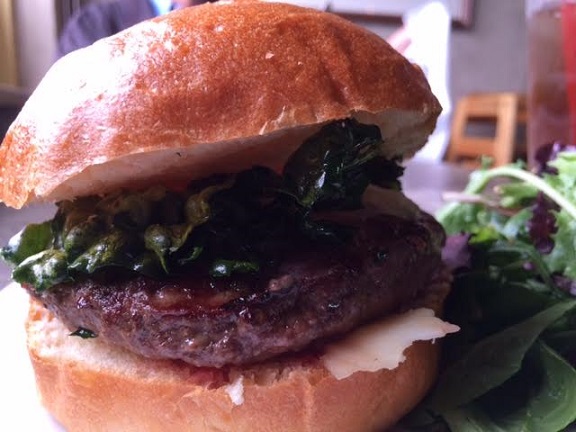
My burger came on a brioche bun and had mustard aioli, microgreens, caramelized onions and a type of bacon whose proper name I couldn't read. Well, it was a heckuva burger, but very rich, in more ways than one. It was very tasty but didn't sit well. Incidentally, the presentation and price, not to mention the setting, invite comparisons to Father's Office in Santa Monica and Culver City.
The half-order of fries I can recommend unreservedly. They come in a paper cone with three dipping sauces. The sauces are OK; the fries are amazing.
As for the beers, the Abbey has some 30 Belgian beers on tap. This is apparently A Big Deal in the beer community, Belgian beer being considered among the best and having it on tap being a rarity. There's no beer list, annoyingly, so you may be hard-pressed to know what to get. My friend tried a couple and liked them. Beer doesn't appeal to me and a sip of one didn't change my mind.
But if you're into it, Back Abbey is almost like a wine bar for beer. It's very non-909 and Claremont's lucky to have it. The clientele ranged from 20s into the 60s that night, and it will be interesting to see this fall if Claremont Colleges students adopt the place and its $7 to $9 beers or whether it remains more of a beer snob/foodie hotspot.
About my only criticism is that it's very LOUD. It's not TVs, it's not music, it's just conversation that makes the interior almost as noisy as a nightclub. I don't know if there's anything to be done about it, other than timing your visit to off-hours.
You can read reviews on Yelp and on the M-M-M-My Pomona blog.
I met Candelario Mendoza, the Pomona educator and school board member who died Tuesday at age 89, only once.
That was two years ago at an event at Mountain Meadows Golf Course. The trim Mendoza was resplendent in a white suit, friendly and full of energy as we spoke.
He asked if I'd read Matt Garcia's "A World of Its Own," a history of immigrants in the Southern California citrus industry before World War II, in which he was quoted. When I said I hadn't, he left -- he lived practically across the street -- and came back a few minutes later with a copy for me.
His vigor lulled me into thinking there was no rush in writing about him. I had hopes of one day sitting down with him for a piece on his very long history in Pomona, specifically about his years as a disc jockey and as emcee for dances at Pomona's fondly remembered Rainbow Gardens night club, about which he's quoted in "Land of a Thousand Dances," a history of Latino music in L.A.
Well, that history has all been documented -- besides the two books, Mendoza was hardly a stranger to Bulletin and Progress-Bulletin readers over the years -- and yet I'm sorry other news and history pieces kept getting in the way of my writing about him.
I'm sure Mendoza would have had a lot to teach me.
East of the Mississippi, fans of sliders -- mini-hamburgers -- may be partisans of White Castle, which predominates in the Midwest and East Coast, or of Krystal, which is popular in the South. Apparently only Kentucky and Tennessee have both chains.
I'm a White Castle admirer and always make a point to eat there once in the St. Louis area on visits home.
I'd heard of Krystal's but had never seen one, having limited experience in the South. Then in New Orleans I happened to pass by one on Bourbon Street near my hotel.
So I squeezed in a between-meal snack of one Krystal burger. (The 92-cent price for an itty bitty burger was a ripoff. Doesn't McDonald's offer double cheeseburgers for 99 cents?)
The two burgers are virtually the same, a couple of inches across, square, served on a dinner roll with a single pickle slice. A Krystal has mustard, while a White Castle has chopped onion and the patty has holes. Is it possible Krystals are grilled while White Castles are steamed?
Well, whatever. Any of you eastern U.S. expatriates want to expound on one chain versus the other?

My waitress takes a break on the Cafe du Monde patio.
Oh, the food in New Orleans! I knew eating would be a highlight and read up in my Lonely Planet guidebook and in Jane and Michael Stern's "Road Food" for tips on where to go so I'd be prepared.
The afternoon I arrived, there was a Creole Tomato Fest, a Zydeco Fest and a Seafood Fest all winding down simultaneously in the French Quarter. Best food item I tried was a crawfish pie, a little 3-inch diameter pie with filling like a crab cake.
One evening I had crawfish etoufee at the Bon Ton Cafe, a 1950s-era spot with exposed-brick walls on Magazine Street in the Central Business District. In etoufee, the meat is served with rice, whereas in jambalaya, the meat is cooked with the rice. The crawfish was like tiny little shrimp except more tender. Mmmm.
(Food, by the way, automatically improves at any restaurant one can reach by antique streetcar, and many of the places I ate at qualified.)
I had po-boy sandwiches at several places. Johnny's in the French Quarter is almost like a deli, with red-checked tablecloths; there I had the oyster po-boy. Mother's, on Canal Street, is reminiscent of L.A.'s Philippe the Original, a great social leveler in which we all line up at a counter, businessmen and laborers alike. Mother's Ferdi Special (roast beef and ham) was very good, and its bread pudding was delicious too. And I had a catfish po-boy at the Trolley Stop.
Tried to go to Domilise's, reputed to be the best po-boy restaurant, but it was closed the day I went, darn the luck. And Casamento's, recommended for oyster loaves, was closed for the season.
(Incidentally, I look forward to my next visit to the Gumbo Pot at L.A.'s Farmers Market, a favorite of mine for a dozen years, although I don't get there often. After New Orleans I now have more of a basis for comparison. The Gumbo Pot's catfish po-boys, served on a French roll with shredded lettuce and wafer-thin slices of lemon, rind and all, is hard to beat.)
The conference I attended -- for the National Association of Newspaper Columnists -- included two buffet meals with multiple Big Easy specialties. One was at Dookie Chase's, one of the most beloved restaurants in town, located in the Treme district. That meal and the other included blackened catfish, red beans and rice, jambalaya and gumbo.
I had beignets at Cafe du Monde, the famous 24-hour coffee house in the French Quarter, but no cafe au lait, having never developed a taste for coffee. (What sort of journalist am I??) Beignets are square donuts without a hole, puffy and dusted with powdered sugar.
Napoleon House had a gloriously ancient bar area but my seafood gumbo was only so-so. I splurged for one fine meal at K-Paul's, the restaurant founded by Chef Paul Prudhomme, where I had blackened beef tenders in debris gravy, plus a cup of turtle soup, which proved to be like a thin chili, with a turtle-like snap to it.
At Central Grocery, the self-proclaimed inventor of the muffuletta, I ordered a half-sandwich, knowing from my research that one is big enough for two people. It's on a big round loaf of bread, sliced lengthwise and stocked with ham, salami, provolone and an olive salad. With a bottle of Barq's root beer in hand, I walked a block to the riverfront to dine al fresco in the late afternoon sun on the banks of the muddy Mississippi.
Ah, New Orleans!
If you've been there yourself, you're encouraged to post about your dining experiences.
New Orleans was, as you'd expect, awesome. Also, still devastated from Katrina and Rita. I'll write about both aspects in a column or two in the coming days. I'll probably blog here about the food.
In the meantime, comments left last week have been posted. Let me direct your attention in particular to a belated comment for the Cock-a-Doodle calendars post left by an unnamed server there. He offers some informative comments on the venerable Chino restaurant, including a report on its "secret menu." Shades of In-N-Out!
No, you can't get the biscuits and gravy Monster Style, but the inside tips about the strawberry shortcake and other items is well worth a read, as well as his fond remarks about Albert the cook and Dotty the waitress.
Just flew back from New Orleans, and boy are my arms tired. (From flapping, not from lifting drinks.)
I'll be posting real stuff, or as real as this blog gets, on Tuesday. Meanwhile, today I'll try to catch up on whatever comments you've left, and any comments you leave starting today will be read soon. Not that I'm giving you anything today to comment on, admittedly. I'm just sayin'.
[For W, I focused on a whole neighborhood, one that has a certain fascination for midcentury architecture buffs because of its tracts designed by Cliff May, creator of the ranch home. Oh, and the two people who run Westmont Hardware turned out to be a couple of authentic characters and well worth meeting. This column was published April 10, 2005.]
'Pomona A to Z' watches over Westmont
Welcome! "Pomona A to Z" today wades into the letter W, as we seek to become well-informed about Pomona, and not in a willy-nilly way.
To which W shall we bear witness? Try not to become weepy as I wistfully whisper of these wonders:
* Willie White, a former councilman, youth advocate and current neighborhood activist whose name is on a park.
* Winternationals, the largest drag-racing event in the world.
* Wilton Heights, a neighborhood of Craftsman bungalows and stately homes designated as a city historic district.
* Western University of Health Sciences, a school of osteopathic medicine that now occupies much of East Second Street, including the old Buffum's department store.
Wild!
As is my wont, though, our W is different: Westmont.
That's the western Pomona neighborhood that exemplified post-World War II optimism. Some 1,200 homes sprung up from 1946 to 1954, along with a shopping center, park, community center, elementary school and church.
With a little imagination, you could picture the superfamily from "The Incredibles" here. Homes along Wright and Denison streets have a similar, if smaller-scale, look to the movie: open floor plans, floor-to-ceiling windows, clean lines and side patios.
And take a gander at Westmont Community Center, Westmont Elementary or Westmont United Methodist Church, all on West Ninth Street. Is that Elastigirl and the kids driving (or flying) by?
Westmont got its start when home builder Edwin A. Tomlin began work on newly annexed land south of today's Mission Boulevard and bisected by today's Corona Expressway.
Most of his homes were standard stuff for returning GIs, but then Tomlin got experimental, hiring architect Arthur Lawrence Millier to design 50 affordable modern homes. Another 100 were prefab modern homes by Cliff May and Chris Choate.
May and Choate's work was described by House and Home magazine as "almost the first low-cost house to offer the kind of California living everybody back East imagines all Californians enjoy."
Maybe W should be for "whoa."
Bruce Emerton has become a neighborhood archivist and booster since buying his home in 1995 for $130,000. He painstakingly restored his 1954 May home to its original look.
An art and architecture librarian at Cal Poly Pomona, Emerton drove me around on Wednesday, pointing out nice homes and shaking his head over ill-advised remodeling.
"A lot of them have been stuccoed and bastardized," Emerton admitted. "A few are in good shape. Even a lot of ones that are messed up could be brought back."
Speaking of messed up homes, people still talk about the 1982 city-sanctioned dynamite blast to close a dangerous cave in the Westmont Hills behind the neighborhood.
Fifteen homes were blown off their foundation and more than 500 were damaged. Oopsie!
A commemorative T-shirt quoting "Butch Cassidy and the Sundance Kid" put it this way: "Think Ya Used Enough Dynamite There, Butch?"
Westmont, though, is best remembered as home to General Dynamics, a missile factory that employed 13,000 at its peak. The plant opened in 1953 as Convair and closed in the early 1990s, the victim of Southern California aerospace cutbacks.
In its heyday, the plant produced missiles with such fun-lovin' names as Red Eye, Mauler, Terrier and Advanced Terrier. Does Jack Russell know about this?
Unlike General Dynamics, one neighborhood icon remains. Westmont Hardware is a cozy store dating to 1949 that's hanging on in this era of Home Depot and Lowe's.
It has just two employees: owners Russell Riedel and Patsy Koenig.
Riedel was hired at the store out of high school in 1967 and has been there ever since, buying it in 1989 from its second owner. He remembers General Dynamics employees crossing Mission Boulevard "like herds of cattle" on lunch breaks, then the bad times later.
Things are more stable now. When the expressway becomes a freeway with a Mission interchange, big changes will come.
"I've been hearing about it 30 years," said Riedel, who's not exactly holding his breath.
Well, that's the story of Westmont.
Was I too wordy?
(David Allen writes Sunday, Wednesday and Friday, three washouts.)
Allan Lagumbay of the Pomona Library Special Collections room was paging through a folder labeled "The Poems of P.C. Tonner" -- Patrick Tonner being one of Pomona's pioneer residents, and apparently one of its pioneer poets to boot -- and found verse he thought was up my alley.
Tonner isn't exactly Lewis Carroll but his tragic acccount of eating away from Pomona is fancifully amusing. And to think, this was before Pomona had Donahoo's. Here's the poem in full:
I've Done A Lot Of Eating
I've done a lot of eating,
In two and fifty years;
I've eaten Chili peppers,
Until my eyes rained tears;
I've eaten potatoes by the score,
Produced from Irish bogs,
And then I've yum-yummed with delight,
O'er luscious snails and frogs.
I've ate the rancid porpoise,
Atlantic tempest tossed,
When fishing near Newfoundland,
All other food being lost;
But in ten days thereafter,
I touched at Doublin Bay,
And dined from beef from Mullingar,
And drank my pousse cafe.
And so I've been accustomed,
To take things as they come,
When lacking Irish Mountain Dew,
I'm satisfied with rum:
And if the chicken's old and tough,
But fair and cleanly served,
The langour of my appetite,
Can scarcely be observed.
But, Shade of Epicurus!
My hungry jaws rebel,
Against the tasteless cooking,
Of this high priced hotel.
Against the lack of beefsteak,
With platter cold as stone;
The scarcity of bread and tea,
Would make an hermit moan.
I came from close to Baldy's Peak,
My appetite was fair,
But weary of my mountain home,
I sought the ocean air,
And came to Santa Monica,
To swell a Sunday throng,
But in a careless moment,
Brought my appetite along.
And this is why I sadly write,
Of what befell me there
I never thought the landlords fed
Their transient guests on air,
And so when in my innocence,
Returning from the Beach,
I sat me down to breakfast,
And asked in joyous speech, --
Just for a bowl of mush and cream,
While they would cook my steak;
I found my joy was all a dream,
And I was full awake, --
And then I almost fainted,
My eyes grew blurred and dim,
The mush was tapioca,
The horrid milk was skimmed.
I turned me to the waitermaid,
And thus to her did say,
"Oh, waitermaid, just take that stuff,
And cast it in the bay;
Let it be food for fishes,
Or for the Leopard seal, --
I fear me much from this entre,
I'll have a sorry meal."
She looked at me with pity,
And archly turned her head,
But as she reached the kitchen door,
She rubbernecked and said
"Don't be so awful dainty",
(It struck me like a screech),
"You ought at least remember,
That you're camping at the Beach".
But soon the waitermaid came back,
A trencher in her hand,
Four plates were set upon it,
She placed it on a stand,
That stood hard by convenient,
And she brought them all to me;
I wipe my swimming eyes with grief,
To tell what I did see. --
A grizzled oal potato,
One little plate did hold,
Another had two biscuits on,
That made my blood run cold;
The third one was a beauty,
It held an ancient steak.
I pointed to the fourth and asked --
She answered "Flannel Cake."
And then I thought of Hamlet
And mused the royal Dane,
Had never had such fearful cause,
To drive him full insane;
The skull of ancient Yorick,
I swear by great St. George,
Could not affect his royal throat,
As this drew up my gorge!!
I looked around for sympathy,
But to my shocked surprise,
I saw but smiling faces,
With laughter lighted eyes,
And when I left the table
And bolted for the door,
The smiles were changed to laughter,
Then broke into a roar;
When I met the guilty landlord,
And shook my fist in hate,
And pointed to my vacant chair,
And to the ancient steak.
But I thought upon the holy day,
And of the name I bore,
But frankly, friends, I must confess,
That inwardly I swore.
I swore by the Great Horn Spoon,
And by the mermaids' caves,
I swore by Neptune's trident,
That stills the stormy wave;
That when I left Pomona next,
E'er thitherward I'd roam,
I'd pack my grip, and then I'd leave,
My appetite at home.
This week's restaurant: Ojiya, 4183 Chino Hills Parkway, Suite J, Chino Hills.
I ate at Ojiya last week but saved the review for this week. It's yet another of the sit-down restaurants in Chino Hills that the masses seem unfamiliar with. But it got good reviews on Yelp, so I met up with a couple of CHills friends for dinner.
Ojiya is in a strip mall -- it's a couple of doors from Peking Deli, a Chinese restaurant reviewed favorably here a while back -- and once you're inside you forget you're in a strip mall. It's a cozy interior with touches of bamboo and with a serious-looking sushi bar. I felt like I was in Little Tokyo.
I ordered various nigiri sushi items, especially ones I rarely see elsewhere: Spanish mackerel, seared salmon, fatty albacore and large scallop, plus my baseline dish, the salmon skin cut roll. (I don't remember the individual prices but they added up to about $24.)
I'm confident in saying that Ojiya is the best sushi I've had in the 909. Then again, there's still Rockuan, another Yelp favorite in Chino Hills that is still on my list.
My friends enjoyed their food, a chicken teriyaki bowl and a salmon teriyaki/crunch roll combination plate. Our only complaint was the green salad of iceberg lettuce was boring. At least it was only $3 for me, and free for them with their meal.
We met up, by the way, at 6:30 p.m. on a weekday, and the place was mostly empty. It quickly began filling up. By 7:45, when we left, the dining room was full.
Actually, my attendance at Rancho Cucamonga council meetings is sporadic at best, but sometimes I surprise them by showing up. (Obviously not last night, since I'm still in New Orleans.)
The city attorney always gives me this shocked look, like "why are you bothering to come here?" Sometimes I sense a mild alarm that, if I'm there, something on the agenda must be ripe for mocking. And occasionally something is, although usually I'm only there because I have time to kill, or space to fill, or feel I need some Rancho material.
I'm rather fond of the Rancho Cucamonga council. There's often some banter among council members that works out well for a humor columnist. Also, the chambers are enormous and comfortable. In Pomona we're packed in like sardines.
What works against the Rancho council is that their meetings are always the same week (first and third of the month) as Pomona's (on Mondays) and Ontario's (on Tuesdays). By Wednesday, when Rancho meets, I'm burned out on council meetings.
Also, going to a third meeting in a week tends to tilt my columns too much toward government news. For those who like that sort of thing, good. For those who don't, it's annoying.
So, to strike a balance, I usually skip Rancho's meetings. Sorry, Rancho.
If you're curious about why I go to council meetings at all, or why I pick Ontario and Pomona to focus on, I'll post about that sometime next week.
Darn the luck, my vacation means that hot on the heels of missing Monday's Pomona council meeting, I missed last night's Ontario council meeting.
This one I kind of regret, given the events at the last meeting, but oh well. I look forward more than usual to hearing what I missed.
Because of vacation, I was absent from last night's Pomona council meeting. Too bad, but then again, if it was anything like the last two, with protesters inside and outside the chambers, it's probably just as well.
There was a period where I arranged vacations specifically to avoid missing Pomona and Ontario meetings; in fact, my attendance record was as good, or even better, than most of the officials'. Then I realized this was stupid.
I'm on vacation all week. In New Orleans, in fact. Let the good times roll!
I'll have a Wednesday column but have to skip Friday's and Sunday's. I will have blog entries daily, however. I promised you, and myself, that I would post daily on this blog for one full year, barring emergencies, and since it's not September 2008 yet, I'm bound to keep posting.
However, yours truly doesn't own a laptop, nor do I really feel like using my vacation time to blog. So what I've done is cheat a bit by writing up something short in advance for each day.
These advance postings aren't dependent on your comments. Because unless I have access to a computer at some point, I won't be able to read your comments until I'm back, and as most of you know, the blog is set up so that all comments must be read by me and posted manually. For this week, then, I've avoided those popular "anyone know whatever happened to...?" posts about local lore.
Feel free to leave comments, but don't be surprised if they don't show up online until next week. In the meantime, enjoy this week's posts -- including a Restaurant of the Week, which is more like a Restaurant of Last Week -- and Wednesday's column.
[After a monthlong break for reasons I can't recall -- vacation? deadline problems? other news crowding to get into my column? -- "A to Z" returned to print with the letter V.
I was happy to write about the Vietnamese community, fulfilling my goal of writing about the main ethnic groups in the city. There is still a vital Vietnamese presence in Pomona, and Pho Vi, a new restaurant, opened last month at Third and Thomas streets downtown. The only update to this piece is that the Vault nightclub, one of the runnerups, is gone.
This column was published March 27, 2005.]
'A to Z' veers toward topic you won't pho-get
Filling a vacuum, my virtuous venture "Pomona A to Z" returns today to venerate that village's virtues (while avoiding its vices).
Yes, we're visiting the letter V, or vice versa. Which V best reflects the voodoo that Pomona does so well?
After vigorously vetting or vetoing a vast variety of V's, I've voted for these vignettes, all vis-a-vis V:
* Veterinary school at the Western University of Health Sciences. Amazingly, it's the only one in Southern California, as well as the only one in the nation headed by a woman.
* Vintage clothing from La Bomba, which dresses visiting rock stars and various locals.
* The Vault nightclub, housed in the 1925 First National Bank building, hence the name.
* Pioneering landowner Ricardo Vejar, who in 1837 co-owned the entire Pomona Valley. A footnote: The city bought 22 acres from his estate in 1922 to launch the L.A. County Fair.
Va-va-voom! Why, these V's practically give me vertigo.
Yet I hope it won't vex you to learn that our V is a different indicator of Pomona's vitality. Our V gives voice to a community that's very valuable: the Vietnamese.
After the April 30, 1975 fall of Saigon to the North Vietnamese -- 30 years ago next month -- many Vietnamese fled communism and misery by cramming themselves valiantly into rickety wooden boats for the vagaries of a sea voyage to neighboring countries for repatriation.
Some 125,000 were accepted as refugees by the United States that year, the vanguard of more than 270,000 that followed by 1982, gaining the world's sympathy.
Many settled in Orange County, but impressive numbers ended up in the Inland Valley. They're concentrated in Pomona, where an estimated 10,000 live.
You may not even know they're there, as the community is less visible than Pomona's majority Latino population.
But a stretch of East Holt Avenue shows their presence. Hoa Binh is a market with Asian food and produce, as well as an eye-opening array of fresh fish. Asian characters can be seen on numerous storefronts.
Rather than experience this vicariously, I invited Diep Fintland to lunch. A real estate broker, she is a leader among local Vietnamese. We met at a popular restaurant, Pho Express, for my inaugural Vietnamese meal.
A type of soup, pho is pronounced "fuh." (Now that you're familiar with pho, no one can call you a fuddy-duddy.)
"Pho, it's like pancakes for Americans. Usually it's for breakfast, but you can eat it 24 hours," Fintland said.
My bowl of Pho Tai -- broth, rice noodles and rare steak -- was delicious, albeit virtually impossible to eat.
The long, pasta-like noodles are meant to be eaten with chopsticks. I'm sure I could have done this if I'd had two hours -- or the 24 hours Fintland mentioned -- but after I fumbled around a while, owner Hoa Phan brought me a fork.
She and Fintland exchanged amused comments in Vietnamese about my struggle, some of which Fintland translated.
"You're eating it like spaghetti!" Fintland joked as I twirled the noodles against my soup spoon with my fork.
Fintland, meanwhile, plucked the thin slices of beef from her pho and expertly rolled them into tubes, all with her chopsticks, for dipping into a saucer of spicy liquid. I shakily carried mine over flat with chopsticks or my fork.
I ate one-third of my pho before deciding to phogeddaboudit.
Much easier to eat, and just as tasty, were Cha Gio, a meaty eggroll wrapped in lettuce, and Phan Tau Hu Ky, crispy cubes of deep-fried tofu around shrimp paste. Now that's eatin'!
The restaurant had a bustling lunch crowd of Vietnamese, Latinos and Caucasians. It re-opened in fall 2004 after several years as Pho 54 under different hands.
Phan's son, Timmy Nguyen, who runs the restaurant, says his family had a hard life in Vietnam before coming here as refugees in 1983.
"That's what has made me successful in the U.S. I don't take anything for granted," said Nguyen, 35, who sold cars for 11 years before helping his mother open the restaurant. He added later: "I adore America."
Fintland came here in 1967 -- by commercial plane -- after high school to join a sister who'd married a serviceman. Their father was killed by the Communists when Fintland was 2.
She and her husband, whom she met in Bakersfield, have lived in Pomona since 1977.
Madelenna Lai and Fintland founded the Pomona organization Vietnamese Cultural House in 1997 to help preserve their roots. In 2002 they sponsored a Rose Parade float, in the shape of a boat, as a way to thank Americans for taking their people in.
"Freedom. A lot of people take it for granted," Fintland observed.
There's a lot of veracity in that.
(David Allen, who's no virtuoso, writes Sunday, Wednesday and Friday.)
Why should we keep a wary eye on Belgium? Two reasons:
1) The Back Abbey, a pub specializing in imported, and pricey, Belgian beers, opened this week in Claremont. (Here's a review.)
2) A Belgium-based brewer made a $46 billion offer for American beer icon Anheuser-Busch.
I don't know what the Belgians want, but it may be our hearts, our souls and our livers.
This week's restaurant: Famous Dave's, 11470 4th St., Rancho Cucamonga.
This is a Minnesota-based barbecue chain that recently opened a location across from Ontario Mills. The large-ish dining room has a high ceiling with rafters, wavy tin trim and silly signs, such as, in neon, "Eat like a pig."
I like barbecue as much as the next person, but I'm not one of those people who know the difference between the styles of St. Louis, Texas, Memphis and wherever. What I can tell you is that I went in for lunch on Tuesday and ordered the Dave's Favorite Burger ($8.99) with a side of slaw. How could this Dave resist?
The burger took a while but the server said that's because the beef is ground only when ordered. It's not this Dave's favorite, but it was a darn good burger, a fine pile of beef chargrilled medium well until crunchy. Too much barbecue sauce, though. Oh, and the slaw was above average, dry and crisp.
My friend had a pulled chicken sandwich ($7.49), quite tasty, and a side of sweet potatoes with brown sugar on top. I'm not a sweet potato fan but I could have eaten more than the bite I sampled.
Is Famous Dave's better than Lucille's, the chain at Victoria Gardens? Is it better than the local places, like Joey's or Red Hill BBQ? Ask an aficionado. But I'd eat at Dave's again. Or any of those places, for that matter.
Weird trivia: Famous Dave co-founded Rainforest Cafe and is a former assistant secretary of the Bureau of Indian Affairs.
When I visited Chino's delightful Cock-a-Doodle for lunch last year before writing about the restaurant's 50th anniversary, I marveled at the vintage calendars papering the walls in the hallway outside the restrooms. They're obviously not original to the 'Doodle since most predate its existence.
Here's a note from reader Toni Bagley about the calendars:
"At the Cock-a-Doodle Restaurant on Central Ave. in Chino, there are a ton of calendars on the wall. We are all so curious about them! They are small (maybe 7"x9") annual calendars starting in 1926 going through 1961. A few years are missing, but not many. They were provided by a business called Soper Bros. It appears that Soper Bros. sold most anything farm or house related.
"The calendars are covered with pencil notations. Most curious are certain 'holidays' or 'events' that no one understands. One is 'Ember Day,' and another is 'Rogation Day.' What do these things mean?
"I've lived here 30+ years, but haven't run across anyone who can explain the history of the calendars. They're a real 'show-stopper' as you are waiting to get into the Ladies Room! Well, they don't 'stop' anything (!), but they are an attraction.
"Thanks for delving into this, David. Also, while you're there, delve into the biscuits and gravy!"
Anyone know the story behind the calendars being there (I'm guessing they were donated), the history of Soper Bros. or what Rogation Day or Ember Day would refer to?
At Saturday's Pomona Information Fair, I said hello to Councilwoman Paula Lantz at the City Council booth and was given my very own official City of Pomona Mayor's Office pencil.
"For taking accurate notes," Lantz said with a smile. Hey, I'll take whatever help I can.
Photographer Richard Nunez was there with spending money from the Goddess of Pomona blogger. He dipped into the stash to buy me a hot dog and a Pepsi -- wasn't that nice? -- and then paid me a compliment, of sorts.
"Do you have a tapeworm in your stomach? I read about how you're always eating at restaurants," Nunez said. "I thought, this guy must be huge" -- he held his arms out in a giant bubble -- "but you're not."
It's all about portion control, Mr. Nunez. At least, I always thought so...
Reader Develyn Sperling left this comment on the "things that aren't here anymore" thread, but let's put it here for you nattering nabobs of nostalgia:
"Does anyone remember a little place called the Tiger Cafe on Holt Blvd in Ontario? My Uncle Tommy owned it. It stayed open after all the Blvd. bars closed. People lined up to get his Sober You Up Chili before driving home.
"What was the name of the tiny diner across the street from it? How's this: On the corner of Holt and Campus. The Bamboo Hut.
"Next door was a liquor store with great penny candy. Next to that was Goldie's variety store. It had great, cheap toys. But she was a mean old bird and kids were actually afraid to go in there.
"Or, the Dairy Queen on Holt, just east of Campus."
Ah, memories. I like the idea of hangover-prevention chili. Anyone want to add details about any of these places?
Clearing out the in-box of my old d_allen e-mail before the account expires, here's a query from Richard Nunez of Pomona:
"A friend and I were talking about the upcoming Pomona Drags at the Fairplex. [No longer upcoming. -- DA]
"Then he said, Do you remember the Lions dragstrip? Yeah, sure do. Then he said, Do you remember the Fontana Drags? My mind went blank for just a moment. Yeah, I do. My folks would take us kids by there to hear them and see them race.
"OK, I was wondering if you can tell me when they started and when they stopped racing. It was on Foothill, I believe it was just past Vineyard going east on Foothill on the north side."
So the Fontana Drags were in Cucamonga? Hmm. Anybody able to shed some light on this?
* UPDATE: The dragstrip was in the present-day Village of Heritage neighborhood (see comments section for more) far, far east of Richard's memory. Sports Editor Lou Brewster gives extra details: "The strip ran north by east, east of East Avenue, by the San Sevaine flood control channel. The worst thing that happened there was a guy literally losing his head...Races usually ran on Sunday. It was part of a circuit that included Lions (Long Beach), Irwindale and Orange County."
As promised in today's column, here's a link to Big Orange Landmarks, a blog with multiple views of L.A.'s Fine Arts Building.
Take a look -- it's a heckuva building.
[My U choice was unknown until the day I finally took at look at that stone marker outside Joey's BBQ. When I read the inscription commemorating the nearby underpass, I laughed out loud there on the street corner. Granted, underpasses aren't unique to Pomona -- but stone markers for underpasses may be! This column was published Feb. 20, 2005.]
Pomona underpass was urgent undertaking for 76 years
It's unnerving, but "Pomona A to Z," my unabashedly upbeat ode to the city's unplumbed depths, is up to the letter U.
Examples aren't ubiquitous, but Pomona does have some unforgettable U runnerups with which you may be unacquainted:
* Underground art galleries in the basement of the Prog and Founders buildings downtown: Gallery 57 Underground, SCA Gallery and SoHo Gallery.
* U Pick U Save Auto Dismantling on East Mission, worth a U-turn by those looking for a replacement hubcap or side mirror.
* Unistar Foods, which provides meat and poultry to Filipino American restaurants and markets throughout Southern California.
Uplifting, eh? However, the U that deserves a chorus of ululation is unique -- and admittedly unpromising.
It's the Garey Avenue underpass.
(That's underpass, not underpants.)
Each day, thousands of motorists pass below the railroad tracks downtown without a second thought.
But it wasn't always this way. Waiting from a few minutes to a half-hour for a train to pass was once a daily occurrence.
Showing that government moves even slower than trains, the problem existed for eight decades before anything was done.
In 1887, the Progress-Bulletin editorialized:
"The railroad crossing at Garey Avenue was blocked last Monday forenoon for a considerable length of time by a freight train, causing no little annoyance and delay to passing to and fro of teams. That is an annoyance that should be abated at once."
"Teams," by the way, referred to horse-drawn wagons. Told you this was an age-old problem.
As Pomona grew, there was talk of building underpasses at the Garey, White and Towne rail crossings. Efforts intensified after July 15, 1948, when traffic was blockaded at noon for a half-hour, then at 1:30 p.m. for another half-hour.
Road rage, anyone?
As if reaching across the years to help me write today's U-themed column, Southern Pacific passenger agent William Campbell told the Progress-Bulletin the incidents were "unfortunate and unavoidable."
Enter Fred Sharp. Hired in 1949 as Pomona's first city administrator, Sharp set about preparing the city for the future. Storm drains, a county courthouse and a new Civic Center were among his achievements before retiring in 1974.
So were rail crossings.
"People were getting killed on the railroad tracks ... There was no program in California for (underpass construction). We had to go to court to force the railroads to cooperate. They claimed they were here first," Sharp recalled in a 1985 interview.
By the late 1950s, railroads were required by state law to cough up money for grade separations. A state fund was set up to provide matching funds for qualifying projects.
Thanks to Pomona's lobbying, Garey, White and Towne made the cut. Pomona voters overwhelmingly passed a $1.5 million bond issue to raise the city's share -- 30 percent -- of the $5.3 million needed.
"It was a great effort. And the business community was strongly behind it," Ora Lampman, hired in 1962 as a city engineer, told me recently.
Towne and White were done first. Construction on Garey began in August 1961. It turned into a nightmare, dragging on for two years because of its complexity.
Vehicle traffic was rerouted and temporary trestles were built to carry the trains.
Some 6,000 truckloads of dirt were hauled off. Then work began on the 110-foot-wide bridge, which supported three sets of tracks and two lanes of First Street.
Like an omelet, you can't create a grade separation without breaking a few eggs. Did I really just type that? Pomona had to demolish a block of First Street on the west side of Garey as well as the 1914 Union Pacific depot.
Further setting this undercrossing apart is what may be the most unusual public works plaque in the Inland Valley.
I'm referring to a 6-foot stone marker rising nobly at the corner of Second and Garey, right outside a barbecue joint.
When I saw this grand monument to a humble underpass, I knew it was worthy of "Pomona A to Z."
Anyway, on Aug. 15, 1963 -- some 76 years after the 1887 editorial -- Pomona held a lavish dedication for the underpass.
Some 1,000 people heard County Supervisor Frank Bonelli praise Pomona for perseverance "that is second to none."
Perseverance that was tested again -- just to sit through all the speeches.
(David Allen writes Sunday, Wednesday and Friday, which is unfortunate and unavoidable.)
Driving west on Holt Boulevard in Ontario on Friday, I noted once more the welcome new construction between Vineyard and the Post Office. The buildings look pretty nice, the sidewalks are in place and so are the streetlights.
Unfortunately, this time I noticed something else: The streetlights are smack-dab in the middle of the sidewalks.
What's up with that? I can forgive that sort of thing in all the '70s and '80s sidewalks around the valley because it was so commonplace. We've learned a lot about planning since then. Really, though, who in 2008 is allowing light poles to be placed in the middle of fairly narrow sidewalks?
I counted six of them. They'll be a dandy obstacle course for moms with strollers and people in wheelchairs.
This week's restaurant: Los Michoacanos Baja Grill, 639 E. Holt Blvd. (at Miramonte), Ontario.
I've stopped at Los Michoacanos a couple of times before Ontario council meetings for a quick bite. It's a broad storefront on East Holt. Walk inside the large space and there's an open kitchen on the left, a money-transfer counter on the right and, through a wide walkway behind them, a carniceria in the back half.
The first time I had very acceptable carne asada tacos. This week I ordered two chicken tacos and a horchata ($4.84). The counterman, who had raced up from the carniceria, seemed delighted by my order: "Have you tried our chicken before? It's marinated in orange juice, cilantro and black pepper. You'll love it."
And I did. Chicken is often bland, but this chicken was full of flavor and did indeed taste of orange juice. They could be the best chicken tacos I've ever eaten.
Perhaps because I was the only customer, the counterman picked up the remote and changed the channel of the TV on the wall from a telenovela to "Family Feud." First time I'd seen John O'Hurley, best known as J. Peterman on "Seinfeld," as host, and he was no Richard Dawson in the charisma department, although he, or at least his suit, had startlingly wide shoulders.
Still, for the question "things fans wear to a football game," when a player guessed "face paint," Hurley brightened. "Face painter -- just like the 'Seinfeld' episode," he declared. And it was a correct answer.
Before Monday's Pomona council meeting, I had a bite at Tijuana's Tacos on West Holt at Wisconsin. Good tacos. The beverage part of my repast was a first: a Mexican Coca-Cola.
I'd always heard a Mexican Coke is more potent. It comes in glass bottles and is often found at your more authentic taquerias. Seeing the Coke in the lineup of bottled sodas on the counter, I took the plunge. Even though a 16.9-oz. bottle cost $1.99.
Well, it wasn't a life-changing experience or anything, but the Mexican Coke did go down smooth. A little Internet research shows it's a popular drink up here among soda fanciers of all ethnicities, who are excited it's now sold at Costco. They say the taste is similar to the Cokes some of us grew up drinking because it's sweetened with cane sugar, not the current sweetener, the nutritionally and environmentally dreaded high fructose corn syrup.
Anyone else want to weigh in on Mexican Coke vs. American Coke?
Waiting to order lunch Tuesday in an Upland pizzeria, I ran into none other but the Dale brothers, proprietors of the Dale Brothers Brewery. I know Curt but hadn't met Andy.
Their Pomona Queen lager and other beers are brewed in Upland, sold at various local restaurants -- and at hip L.A. eateries Pizzeria Mozza and the Hungry Cat -- and served during Second Saturday Art Walks in Pomona.
At lunch, each brew-bro wore a career-appropriate T-shirt. Here's each brother and his shirt's slogan:
Andy: "As a matter of fact, I do smell like a brewery."
Curt: "Buy a man a beer and he'll waste an hour, teach him to brew and he'll waste a lifetime."
Rare art by Milford Zornes is on exhibit in Rancho Cucamonga, and it looks like time is running out to take a look. Reader Bob Constant saw the exhibit last Friday and says it's made up of paintings done by Zornes in World War II while stationed in China, Burma and India in 1943-44.
Says Constant: "The 86 paintings exhibited show scenes and life of the region. The battle scenes painted by Zornes were retained by the government and are not part of the exhibit, but civilian artworks were returned to the artist and are displayed. They comprise a significant historical record of life and times of that period. If you haven't seen the exhibit yet I think you would find it very interesting and informative."
And y'know, I probably would, and maybe you would too. But time's a-wastin': The museum is open Friday through Sunday and the exhibit, which began May 2, ends Sunday. Yikes! Hours are noon to 5 p.m. and admission is free (my kind of price).
The place: The Chaffey Community Art Association Museum of Art -- whew! -- in the north wing of the J. Filippi Winery, 12467 Base Line Road, Rancho Cucamonga. Phone: (909) 463-3733.
Following up on her hard-hitting Stinky's query, Mary Simon socked me with another set of recollections and questions for the readership:
"I have another question or two, one of which I KNOW that no one but me will remember." [Don't be too sure, Mary. -- DA]
"When I was 4 or 5 years old (late 1950s), there was a pony-ride place called Woolery's. I'm pretty sure it was on Euclid, in south Ontario. There were two paths you could ride in -- the walking lane or the trotting lane. As young as I was, I always chose the 'walking' lane.
"In later years, I showed hunters and jumpers through southern/central California. I trained at a place in Pomona -- the Parnell girls academy. It was a residential school for girls, but also a riding school where peasants like myself could take lessons. Does anyone remember Parnell?"
I'm not sure which one Mary assumes no one will remember. Just to be safe, let's try to dredge up anecdotes about each, OK?
[Somewhere along the line I'd heard Shelton's was a cult favorite and thus its product was tailor-made for the letter T.
Of the runnerups, the trompe l'oeil paintings were nixed because it was hard enough getting one photo into print, much less two. There was also a lobbying effort (an e-mail or two) by the Tony's French Dips people, who contacted me several letters in advance to make a pitch. Tony's would have been worthy too and will probably make my column at some point this year.
This column was published Feb. 6, 2005.]
Calling today's 'A to Z' column a turkey is fair game
For Super Bowl Sunday, "Pomona A to Z" touches down on T.
Yes, this series' trajectory means it's time to pay tribute to the alphabet's 20th letter.
Let me tell you, Pomona is a tableau that's teeming with T's, each contributing to the texture of that tremendous town, each a triumph that ought to be trumpeted.
Tingle at these tidbits:
* Twinkies at the L.A. County Fair -- deep-fried, of course.
* Trompe l'oeil ("trick of the eye") murals: one on the wall of a city parking lot at Second and Garey and another on the Sign-Wize office at Park and Monterey.
* Totem pole towering in the front yard of the home at Arrow Highway and Wilkie Drive.
* Two Thai restaurants in the same block of South Indian Hill: Sanamluang and Mix Bowl. They're tip-top.
* Todd Memorial Chapel, a funeral home owned and operated by the same family since 1907.
* Tony's French Dips, a Police Department favorite that's served sandwiches since 1958. Cook Angie Campos has been dipping for three decades.
* Tacos, tortas and tortillas at Tropical Mexico (often known as Trop Mex) and other traditional taquerias.
Treasures all! And now that you've got the thrust of my theme, let me thrill you by revealing the T we're tackling:
Turkeys from Shelton's Poultry.
Getting a turkey from Shelton's is an Inland Valley tradition. As Thanksgiving approaches, there's often a line out the front door and around the corner for Ben Franklin's favorite bird.
"It's a social event," said chief financial officer Ruth Flanagan, whose family owns Shelton's.
Some customers have been coming for decades, and they love to share their memories of past purchases -- talking turkey, as it were -- with the staff.
Rich Havlena of Montclair has been buying Shelton's turkeys for 30 years.
"You can taste the difference," the retired phone company man, 62, told me. "And you can't hardly screw 'em up."
Good news for once-a-year turkey chefs everywhere.
Fresh turkey wasn't such a rare commodity in the olden days. The Pomona valley once had five turkey ranches, until they were gobbled up (har!) for development.
Shelton's began in 1924, when newlyweds Margaret and O.J. Shelton got a unique wedding present: two turkeys. Hey, it beats another blender.
The couple bred their hen and tom and later began selling turkeys for meat. They had a ranch of about 15 acres at Franklin and San Antonio avenues, near today's Simons Middle School.
O.J. Shelton died and in 1969 so did Fred, their son -- the product of their personal breeding program.
Egg distributor Ken Flanagan and his family bought the business from Margaret that year. The Pomona natives have owned it ever since. Ken is retired, but four Flanagan sons and a sister-in-law share the business equally.
Shelton's got out of the ranching business in 1970, when a farm in the middle of a suburb had become impractical.
"You need to be in a rural area. This isn't rural anymore," CEO Gary Flanagan said.
Turkeys are now raised in Fresno and slaughtered in Turlock, then shipped south. The Pomona facility on Loranne Avenue does cutting, boning and packaging, as well as retail sales.
Shelton's sells 150,000 turkeys a year and 650,000 chickens, for $15 million in gross revenue -- a decent output, but a far cry from Foster Farms.
"We've survived because we're a niche market," Gary Flanagan told me.
All Shelton's turkeys and chickens are free range, meaning they're raised outdoors and get more exercise, Flanagan said. Their food is natural and they aren't given any chemicals.
As a company motto goes: "Our chickens don't do drugs."
(I believe their turkeys are warned: "Just gobble no.")
Natural food stores and specialty markets such as Whole Foods and Wolfe's in Claremont stock Shelton's products, which include broth, canned chili and frozen entrees.
"We're kind of the Tyson's of the natural food business," Flanagan said. "We sell natural food products in all 50 states."
Some high-end restaurants, notably L.A.'s venerable Pacific Dining Car, serve Shelton's chicken.
To my knowledge, Shelton's did not supply any turkeys to "WKRP in Cincinnati" sitcom character Arthur Carlson for his radio station's ill-fated Thanksgiving promotion.
You may recall how a shopping center was bombed with live turkeys from a helicopter, leading to Hindenburg-like chaos.
"As God is my witness," a shaken Carlson said later, in a classic moment of television, "I thought turkeys could fly."
(David Allen writes Sunday, Wednesday and Friday, three more turkeys.)

A journalist for more than two decades, David Allen has been writing a column for the 

Recent Comments
dennis anderson on Fontana (?) Drags: I remember this trac
Crystal Caministeanu on Dueling signs: Way to support local
Jeff Staten on Vineyard and Holt: I worked at the Mura
Katy on Things are tough all over: Well if those are th
PS on R.I.P.: Mama's Grill: I have never been so
hugh.c.mcbride on Restaurant of the Week: WaBa Grill: The Clippers: like g
Eberlin on Restaurant of the Week: WaBa Grill: The Clippers: like g
hugh.c.mcbride on Restaurant of the Week: WaBa Grill: It's like Pinkberry
Warren on R.I.P., Knockers: I remember when it w